
U Visa for Crime Victims in Las Vegas: Who Qualifies, How It Works, and What to Expect in 2026
If you’re searching for U‑visa crime victims Las Vegas help, you’re probably carrying two heavy things at once: the impact of the crime and the fear of what could happen next. Many crime victims in Las Vegas and Clark County want to cooperate with law enforcement, but they also worry about their immigration status. In many cases, however, the U‑visa exists precisely for this situation — to protect victims and strengthen public safety.
This 2026 guide explains, in plain language, who may qualify, how the process generally works, and what to realistically expect. Every case is unique, so this is general education — not legal advice. Still, understanding your options is always the first step toward protecting your future in Las Vegas.
⚠️ Disclaimer:
This article provides general information about the U‑visa for crime victims and should not be construed as legal advice. Immigration law is complex, and every case is unique. Reading this content does not create an attorney‑client relationship. For advice specific to your situation, consult a licensed immigration attorney.
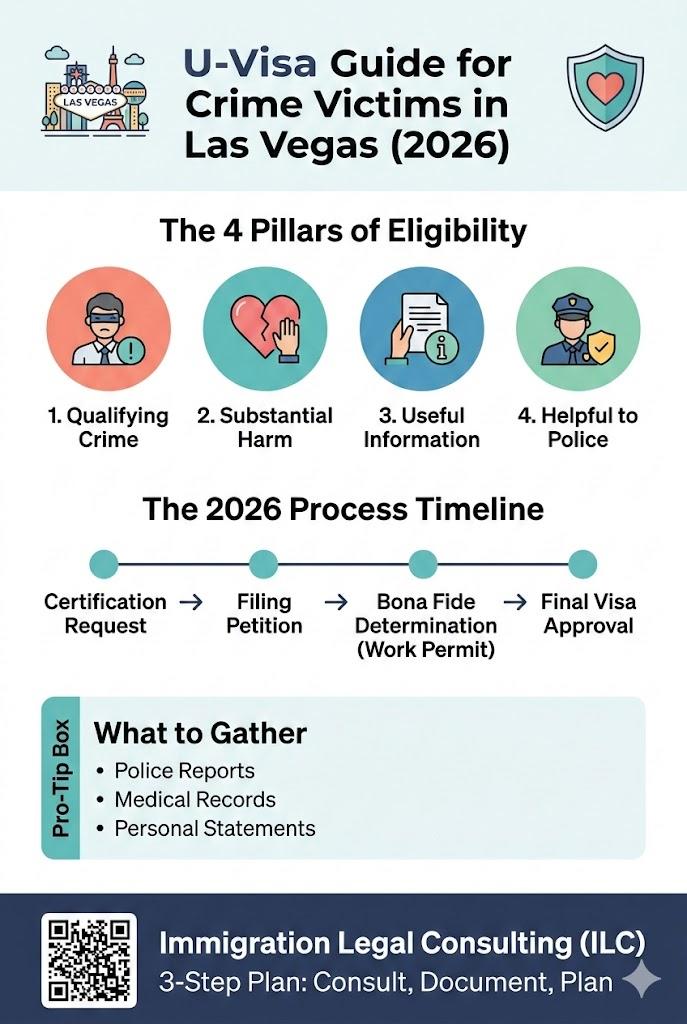
What is the U‑visa, and why does it matter for Las Vegas families?
The U‑visa — officially called “U nonimmigrant status” — is a federal immigration benefit for crime victims. Congress created it in 2000 through the Victims of Trafficking and Violence Protection Act (VTVPA). The reasoning is straightforward: when victims fear deportation, they don’t report crimes. As a result, criminals stay free and communities suffer.
The U‑visa addresses that problem directly. In general terms, it may allow a qualifying crime victim to live and work legally in the U.S. for up to four years. Additionally, some family members may also qualify. Finally, after meeting further requirements, a U‑visa holder may eventually apply for a green card.
For families across Las Vegas, Henderson, and Nevada, the U‑visa can mean far more than a travel document. It can mean safety, stability, and a clear path forward.
Who may qualify for U‑visa crime victims Las Vegas cases?
USCIS applies several eligibility requirements, and applicants generally must meet all of them. One simple way to think about it: crime + harm + information + cooperation.
Was the crime a qualifying crime?
First, the criminal activity must have occurred in the United States or violated U.S. federal law. The qualifying crime list is specific. However, some of the most common ones include:
Domestic violence
Sexual assault
Human trafficking / involuntary servitude
Stalking and kidnapping
Robbery and extortion
Witness tampering or obstruction of justice
Murder or manslaughter (attempted or completed)
Fraud in foreign labor contracting
Importantly, USCIS does not require an arrest, a prosecution, or a conviction. What matters, instead, is that the crime occurred and that you were a direct or indirect victim.
Did you suffer substantial harm?
Second, you must show that the crime caused you meaningful harm. This does not mean your injuries had to be severe or visible. Emotional and psychological harm also qualifies. For instance, a therapist, counselor, or doctor can provide evidence that supports this part of your case.
Do you have information about the crime?
Third, you must possess specific, credible, and reliable information about what happened. In other words, you need to describe the facts — what occurred, who was involved, and how it affected you. Typically, this requirement is met if you reported the crime or cooperated with investigators.
Have you cooperated with law enforcement?
Fourth — and most critically — a certifying official must confirm your cooperation in writing. This person is typically a police detective, prosecutor, judge, or another qualifying agency representative. They sign Form I‑918, Supplement B, certifying that you were helpful, are being helpful, or are likely to help in the investigation or prosecution. Without this signed certification, USCIS cannot approve your petition.
What if I am afraid of reporting the crime?
This concern comes up constantly among crime victims in Las Vegas and across Clark County. It’s a completely fair worry — especially in mixed‑status families. However, several important points can help put this fear in perspective.
To begin with, you do not need existing legal immigration status to apply. Additionally, cooperation does not always mean testifying in open court. It can include reporting the crime, giving a written statement, or assisting an investigation in another way.
Furthermore, while you wait for USCIS to process your case, you may qualify for deferred action — a temporary protection from deportation. You may also apply for a work permit (Employment Authorization Document, or EAD) during the waiting period.
Still, every situation is different. Therefore, speaking privately with a licensed immigration attorney before taking any steps is always the safest approach.
How does the U‑visa process work in 2026?
The U‑visa process has several stages. Here is a general overview of how it typically unfolds for applicants in Nevada — not a legal roadmap for your specific case.
Step 1: Request the law enforcement certification
Before filing with USCIS, you generally need a certifying official to sign Form I‑918 Supplement B. Certifying agencies hold the discretion to approve or deny the request. Also, each agency follows its own process and timeline.
However, an immigration attorney can help you identify the right certifying agency, prepare your request clearly, and follow up professionally on your behalf.
Step 2: Gather your supporting documents
Strong U‑visa applications include solid evidence. For example, you should gather:
A police report or case number
Court records (protective orders, criminal charges, or case outcomes)
Medical or counseling records that document harm
A detailed personal statement describing what happened and how it affected you
Proof of family relationships, if you are including family members
Step 3: File Form I‑918 with USCIS
Once your certification is signed, your attorney files Form I‑918 along with Supplement B and all supporting documents. At this point, your case officially enters USCIS’s review queue.
Step 4: Receive a bona fide determination
Next, USCIS reviews your application to determine whether it appears genuine and complete. This review is called a bona fide determination (BFD). In 2026, applicants typically wait one year or more just for this initial step.
If USCIS grants a bona fide determination, you may then receive deferred action and apply for a work permit while your full case is pending.
Step 5: Wait for final approval
This is the longest stage of the process. USCIS approves only 10,000 U‑visas per fiscal year nationwide. As of 2026, roughly 250,000 applications are pending in the queue. Consequently, many applicants wait seven to eight years or more for a final decision.
This is not a reason to give up. Instead, it is a reason to file a strong, complete application as early as possible — because your wait time starts the day you file.
Processing times are current as of February 2026. Because USCIS timelines change frequently, always check USCIS.gov for the most recent updates before relying on these figures.
What mistakes can hurt a U‑visa case in Nevada?
In 2026, USCIS has increased scrutiny of U‑visa petitions. Therefore, a weak or incomplete application can face serious delays — or worse, a denial. Here are the most common mistakes to avoid:
Filing without the certification
Without Form I‑918 Supplement B, USCIS cannot approve your petition. Never file before securing this document.
Writing a vague personal statement
USCIS uses your statement to assess credibility. A short or unclear statement significantly weakens your case.
Skipping evidence of harm
Medical records, therapy notes, and counseling documents help prove substantial abuse. Do not leave this evidence out.
Underestimating the crime category
Some cases involve crimes where harm or coercion is less obvious. An attorney can evaluate whether your situation clearly qualifies.
Waiting too long to file
The earlier you submit your application, the earlier you hold your place in line. Every year of delay simply extends an already long wait.
Can family members join a U‑visa case?
In many situations, yes. Depending on your age and your family members’ ages, you may include:
Your spouse
Your unmarried children under age 21
Your parents, if you are under age 21
Your unmarried siblings under age 18, if you are also under age 21
Family members join the case through Form I‑918A. However, every situation is different. A licensed immigration attorney can clarify who may qualify in your specific circumstances.
Can a U‑visa lead to a green card?
A U‑visa approval does not automatically grant a green card. However, it can open that door. After holding U nonimmigrant status for three years, and after meeting additional requirements — including continued law enforcement cooperation — you may become eligible to apply for lawful permanent residence.
This pathway is real, but nothing is guaranteed. Additionally, it carries its own eligibility requirements and timeline. A licensed attorney can explain whether — and when — this option may realistically apply to your situation.
How ILC helps U‑visa crime victims in Las Vegas and Henderson
We understand how hard it is to come forward after a crime — especially when your immigration status feels uncertain. At Immigration Legal Consulting (ILC), we believe that crime victims in Las Vegas, Henderson, and across Nevada deserve to feel heard, protected, and guided with care.
ILC focuses exclusively on immigration law, because immigration is too complex to treat as a side practice. Our founder, Shaina Plaksin, graduated magna cum laude from UNLV Boyd School of Law. She is also a proud member of AILA (American Immigration Lawyers Association) and clerked for the U.S. District Court for the District of Nevada. As a result, she brings real federal litigation experience to every client she serves in Clark County and beyond.
Furthermore, ILC offers affordable fees and flexible payment plans, because every crime victim in Nevada deserves access to quality legal help — regardless of immigration status.
Your simple 3‑step plan to get started
If you were a crime victim in Nevada and the U‑visa may apply to your situation, here is a clear and calm plan for today:
1. Consult a licensed immigration attorney privately first.
Share your facts in confidence. An attorney can tell you whether your situation may qualify and what steps to take next.
2. Do not approach law enforcement alone yet.
The certification request is a strategic step. An experienced attorney can identify the right agency and present your request in the strongest possible way.
3. Start gathering your documents now.
Begin collecting police reports, medical records, and written accounts of what happened — even before you file. Early preparation always pays off.
Conclusion: You deserve protection, not fear
Imagine moving through Las Vegas without the constant weight of fear — knowing that speaking up will not cost you your family, your home, or your future. The U‑visa exists precisely for this reason: to give crime victims the safety to come forward.
No outcome is guaranteed, and every case is unique. However, acting early — with a licensed attorney who knows immigration law — gives you the strongest possible foundation. You are the hero of this story. ILC is simply here to guide you through it with empathy, clarity, and a concrete plan.
Not Sure If You’re Ready to Talk to a Lawyer Yet?
Get a Free Preliminary Immigration Case Review
Before committing to legal advice, this free review helps you see the landscape—how situations like yours are generally viewed, what processes and forms are commonly involved, and where cases often run into trouble.
It gives you the context and clarity to decide whether and when speaking with a lawyer makes sense.
- ✅ No legal advice.
- ✅ No pressure.
- ✅ Just a clear, high-level roadmap.
For informational purposes only. No attorney-client relationship is created.
Contacting the firm by phone, email, or website does not create an attorney-client relationship. Do not send confidential information until a written representation agreement is signed. The firm is licensed only where stated (e.g., Nevada and California).
Required Disclaimers
- General information only: This is not legal advice.
- No attorney-client relationship: Contacting the firm by phone, email, website form, or social media does not create an attorney-client relationship; a formal relationship is not created until a contract is signed.
- Confidentiality warning: Do not post or send sensitive facts (names, A-numbers, court dates) through comments or unsecured forms.
- No guarantees: Immigration outcomes depend on the facts and the law at the time; nothing on this page promises a result.