Mixed-Status Families in Las Vegas: Protect U.S. Citizen Children (2026)

If you’re part of a mixed-status family in Las Vegas, you may feel like you’re constantly waiting for bad news. You might be thinking about your kids at school in Clark County and wondering what would happen if immigration officers stopped you, detained you, or placed you in immigration court. That fear is real—and it can make it hard to sleep, work, or even plan for next month.

The good news is that many families have options. Still, those options depend on your unique facts, your history, and what’s happening in your case right now. This 2026 guide explains general steps families often take to protect U.S. citizen children when a parent faces deportation in Nevada.

Disclaimer (general information / not legal advice)

This article provides general information and should not be construed as legal advice. Immigration law is complex, and every case is unique. Reading this content does not create an attorney-client relationship. For advice about your situation, consult a licensed immigration attorney.

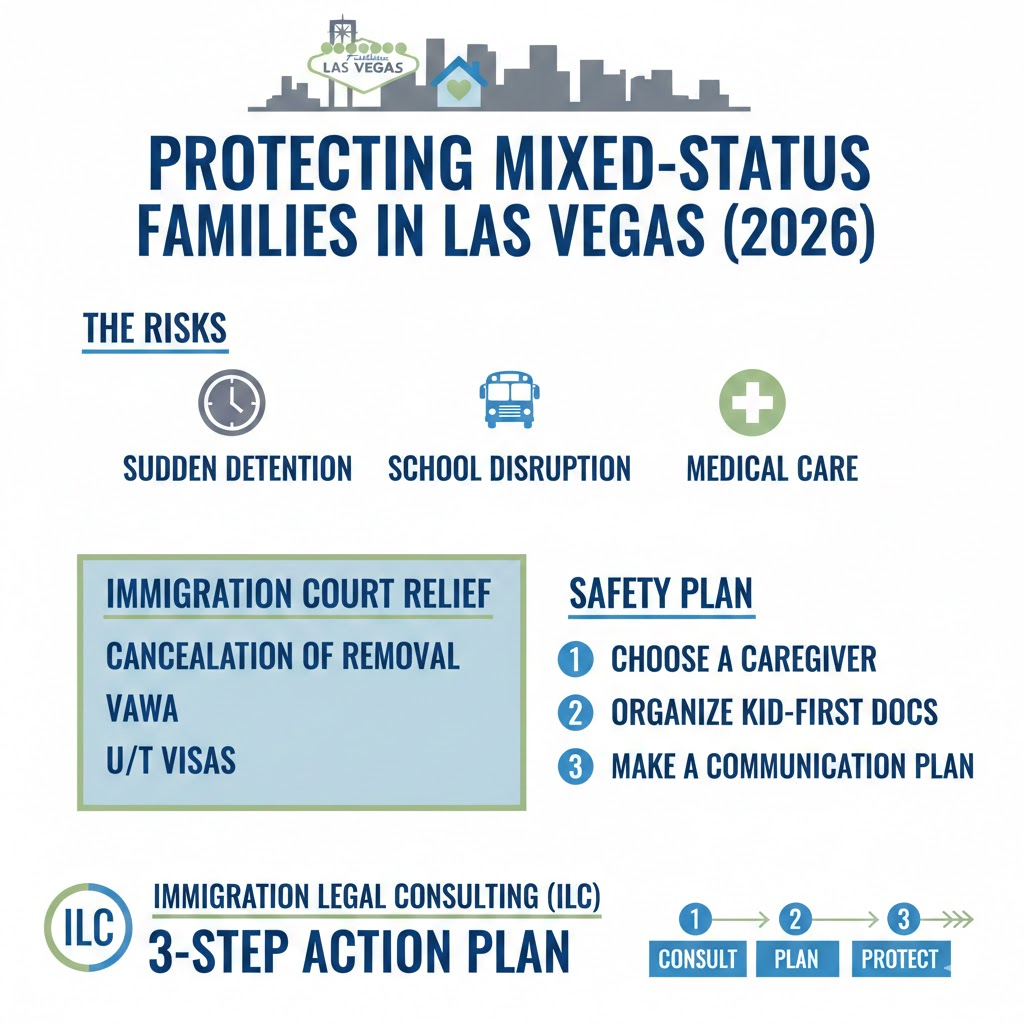
An infographic for mixed-status families in Las Vegas outlining a 2026 safety plan to address risks like detention and school disruption, featuring immigration court relief options like cancellation of removal and VAWA.

What does “mixed-status families Las Vegas” mean?

A “mixed-status family” usually means a household where some family members are U.S. citizens or lawful permanent residents (green card holders), while others are undocumented or have a different immigration status. In Las Vegas and Henderson, this often looks like U.S.-born children living with one or both parents who do not have permanent immigration status.

This matters because deportation (also called “removal”) can affect the whole family—especially children—even when the children are U.S. citizens. It also means your family may need both legal strategy and family planning at the same time.

What are the biggest risks to U.S. citizen children if a parent is detained or deported?

When a parent faces deportation, the biggest risk for your child is sudden instability. A child may lose daily care, routines, transportation, and financial support—often with little warning.

Here are common pressure points mixed-status families in Nevada may face:

Sudden detention

If a parent is detained, childcare plans can fall apart overnight.

School disruption

Kids may miss school, switch schools, or struggle emotionally.

Health coverage and medical care

A child may lose access to a familiar doctor or caregiver who manages appointments.

Housing and income stress

Losing a working parent can create rent and food insecurity fast.

Long-term separation

If a parent receives a removal order, reunification can become harder and slower.

You can’t control every risk. However, you can reduce chaos by making decisions early—before a crisis forces choices in a single afternoon.

What immigration court options may help keep your family together?

If you (or your spouse) are in immigration court, an attorney may look for forms of “relief,” which means a legal way to fight removal or ask the judge for permission to stay. Eligibility depends on many details, so think of this as a menu of possibilities—not a promise.

Could cancellation of removal be an option?

Cancellation of removal is a type of immigration court relief that may allow some people to stay in the U.S. if they meet strict requirements. In many cases, one key issue is whether deportation would cause a very high level of hardship to a qualifying relative—often a U.S. citizen child.

Because the hardship standard is high and the evidence must be specific, families often need strong documentation (medical, educational, psychological, and financial). A licensed immigration attorney can help you understand whether your family’s facts could fit this type of case.

Could VAWA, a U visa, or a T visa apply?

In some cases, a parent may qualify for humanitarian protections, such as:

  • VAWA (Violence Against Women Act) protections: These may apply when a person suffered qualifying abuse by a U.S. citizen or permanent resident spouse or parent.
  • U visa: This may apply for certain crime victims who helped law enforcement.
  • T visa: This may apply for survivors of human trafficking.

What if the parent is detained?

If a parent is detained, the case can move fast. Some people may be eligible to ask for release through a bond process or other procedures, depending on the facts and the government’s allegations.

Current as of February 2026: Immigration rules and agency practices can change. Verify current guidance with USCIS/EOIR or a licensed attorney before relying on any general timeline.

What family safety planning steps can help protect your children?

Legal defense matters. But your children also need a practical plan if a parent is suddenly unavailable. A safety plan is not about giving up. It’s about protecting your kids from panic and uncertainty.

Step 1: Choose a trusted caregiver (before an emergency)

Many families pick a trusted adult—like a grandparent, aunt, uncle, or close family friend—who can care for the children in an emergency. The best choice is someone who can reliably pick up your child from school, provide stable housing, and communicate with doctors.

Step 2: Organize “kid-first” documents

In many families, a simple document folder reduces stress immediately. Consider keeping copies (paper and digital) of:

  • Children’s birth certificates
  • School contact list and schedules
  • Immunization records and pediatrician information
  • Health insurance cards
  • Emergency contacts (two backups, not just one)

Step 3: Make a communication plan your child can understand

Kids do better with simple, honest language. Many parents choose a short plan like: “If I’m late, you will go with Aunt ____.” The goal is calm—not fear.

Step 4: Talk to an attorney about guardianship tools

Some families may want formal legal tools so the caregiver can make decisions for the child. The right tool depends on your situation and Nevada law, so it’s smart to ask a Nevada attorney what is appropriate.

What mistakes can make a scary situation worse?

When fear is high, rumors spread fast. Unfortunately, some common mistakes can reduce your options later:

Missing immigration court dates

This can lead to serious consequences, including orders that may be difficult to reopen.

Signing documents without understanding them

Some papers can affect your rights in ways you did not expect.

Relying on “notario” advice

Notarios are not attorneys in the U.S., and bad filings can harm your case.

Waiting too long to get help

Early planning often creates more options than last-minute emergencies.

Confidentiality reminder: Do not share confidential immigration details in blog comments, email, or social media. Sensitive facts should be discussed privately with your attorney.

How can Immigration Legal Consulting (ILC) guide your family in Las Vegas?

You deserve a guide who understands both the law and the emotions behind it. At Immigration Legal Consulting (ILC), we aim to simplify the process so you can move from overwhelmed to informed.

Our founder, Shaina Plaksin, graduated magna cum laude from the University of Nevada, Las Vegas (UNLV) Boyd School of Law and is a member of the American Immigration Lawyers Association (AILA). We serve families across Las Vegas, Henderson, and Nevada, and we understand how much is at stake when U.S. citizen children are involved.

Your 3-step plan (simple and calm)

1. Get a private legal consult.

Ask what options may apply in your situation and what deadlines matter most.

2. Build your child protection plan.

Choose a caregiver, organize documents, and set emergency contacts.

3. Stay consistent and organized.

Keep records, track court dates, and avoid rushed decisions based on rumors.

Conclusion: Protect your kids with a plan, not panic

If you’re part of a mixed-status family in Las Vegas, you shouldn’t have to face this fear alone. This isn’t just about paperwork or court—it’s about your child’s stability. Imagine the relief of knowing: “If something happens, my kids will be okay tonight—and we have a legal plan for tomorrow.”

Not Sure If You’re Ready to Talk to a Lawyer Yet?

Get a Free Preliminary Immigration Case Review

Before committing to legal advice, this free review helps you see the landscape—how situations like yours are generally viewed, what processes and forms are commonly involved, and where cases often run into trouble.

It gives you the context and clarity to decide whether and when speaking with a lawyer makes sense.

  • ✅ No legal advice.
  • ✅ No pressure.
  • ✅ Just a clear, high-level roadmap.

For informational purposes only. No attorney-client relationship is created.

Contacting the firm by phone, email, or website does not create an attorney-client relationship. Do not send confidential information until a written representation agreement is signed. The firm is licensed only where stated (e.g., Nevada and California).

Leave a Reply

Your email address will not be published. Required fields are marked *