H-1B Wage-Weighted Selection 2026: What Employers and Workers in Las Vegas Need to Know

The H-1B wage-weighted selection 2026 rule changes how USCIS picks cap registrations. Instead of a random draw, the new system gives more chances to job offers with higher wage levels. If you or your employer work in Las Vegas, Henderson, or anywhere in Nevada, this shift may affect your odds and your planning for the FY 2027 cap season.

This is not just a paperwork update. For many families, it affects jobs, stability, and the ability to keep building a life in Las Vegas.

⚠️ Legal disclaimer

This article provides general information about H-1B policy changes. It is not legal advice. Immigration law is complex, and every case is unique. Reading this content does not create an attorney-client relationship. For advice about your specific situation, speak with a licensed immigration attorney.

A checklist for Las Vegas employers highlighting strategic steps for H-1B success, including wage consistency, early role design, and compliance checks.

What changed in the H-1B lottery for 2026?

DHS published a final rule on December 29, 2025, and the rule took effect on February 27, 2026. For the FY 2027 cap season, USCIS now uses a wage-weighted selection method — not an unweighted random draw.

USCIS expects to open the FY 2027 registration period from March 4 to March 19, 2026, and to announce selections by March 31, 2026. If USCIS selects your registration, you can generally file your H-1B cap petition from April 1 through June 30, 2026.

Why this matters in Las Vegas: If your Las Vegas or Henderson hiring plan depends on cap-subject H-1Bs, wage strategy and timing may matter more than ever before.

How does H-1B wage-weighted selection work?

Under the new system, USCIS gives each registration a number of “entries” (chances) based on the wage level of the job offer. USCIS uses the four OEWS wage levels — Levels I through IV — to set the number of entries per registration.

Here is how the entries break down:

  • Level IV (senior/fully competent): 4 entries — highest odds

  • Level III (experienced): 3 entries

  • Level II (qualified): 2 entries

  • Level I (entry-level): 1 entry — lowest odds
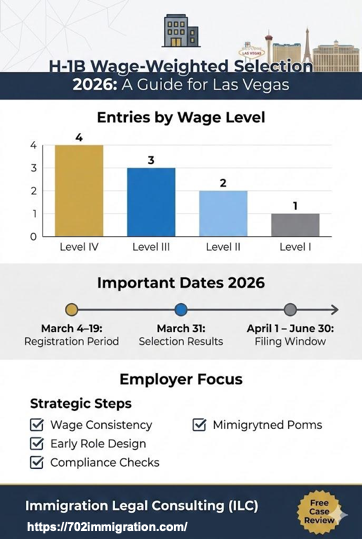
In plain terms, a Level IV offer gets four times more chances than a Level I offer for the same occupation and location.

What is an OEWS wage level?

OEWS stands for Occupational Employment and Wage Statistics. The U.S. Bureau of Labor Statistics (BLS) runs this program and publishes wage estimates by occupation and area. Employers look at that data to match the job’s duties, experience, and salary to the right wage level.

Quick plain-English example

Imagine two employers in Las Vegas register two workers for similar roles. One employer offers a Level IV salary, and the other offers Level I. USCIS gives the Level IV registration four entries and the Level I registration one entry in the same pool. The Level IV registration has better odds — but neither has a guarantee.

What does the new rule mean for employers in Las Vegas?

If your company in Las Vegas or Henderson sponsors H-1B workers, this rule likely pushes you to plan earlier and document more carefully. Below are general points that many employers discuss with their immigration attorney:

Wage planning affects your odds.

A higher wage level gives your registration more entries, which may improve selection chances.

You must pay what you register.

The salary and wage level you record at registration must reflect what you will actually pay. You cannot lower it later to improve your odds.

Job details must be accurate.

The occupation code and work location determine the correct wage level, so both need to be precise.

USCIS watches for manipulation.

If USCIS finds that you inflated the wage level just to gain more entries, it may deny or revoke the petition.

Your 3-step plan (for employers)

  1. Define the role clearly — duties, location in Las Vegas or Henderson, start date, and business need.

  2. Match the wage, wage level, and documentation before the March registration window opens.

  3. Get legal review early so your registration and petition stay consistent and defensible.

This is general information, not legal advice for your company. No outcome is guaranteed.

What does the new rule mean for workers in Nevada?

If you are a skilled worker and your employer plans to sponsor you in Las Vegas or elsewhere in Nevada, your selection odds may depend on the wage level your employer attaches to the role.

Here are general points every worker should understand:

A higher wage level may help.

USCIS gives higher-wage registrations more entries, so your odds may go up.

A lower wage level is still allowed.

However, it comes with fewer entries and lower selection odds.

Multiple registrations carry risks.

Under the integrity rules, USCIS uses the lowest wage level when more than one registration exists for the same person.

No one can promise selection.

Even at Level IV, the annual cap still applies and selection is never certain.

If your family in Las Vegas depends on your work authorization, cap season can feel stressful. You deserve clear information and a realistic plan — not guesswork.

Current as of February 2026: USCIS rules and procedures change frequently. Confirm current requirements at USCIS.gov or with a licensed attorney before you make any decisions based on this article.

What compliance mistakes can hurt you under the new system?

USCIS now places more weight on process integrity. The agency looks closely at whether registration details match what you later file in the petition. Mistakes in this area can lead to denials or revocations.

Watch out for these common problem areas:

Mismatches between registration and petition.

If the wage level, location, or core job details change without a valid reason, USCIS may flag the case.

Weak documentation for the wage level.

If your evidence does not clearly support the level you chose, USCIS may push back.

Last-minute planning.

Rushing your decisions right before the March window opens increases the chance of errors you cannot fix later.

Does this rule change the total number of H-1B visas?

No. The annual H-1B cap stays at 65,000 visas for the regular cap and 20,000 for the U.S. advanced degree exemption. The wage-weighted rule only changes how USCIS picks registrations inside those caps — it does not add or remove visas.

Independent projections suggest the new system will shift more selections toward higher-wage registrations, which may change which occupations and industries see the most wins during the March 2026 registration season.

Conclusion

The H-1B wage-weighted selection 2026 rule changes the playing field for employers and workers in Las Vegas, Henderson, and across Nevada. The goal is not to guess — it is to build a strategy that matches the role, the wage, and the compliance rules before the March window opens.

If you have questions about H-1B sponsorship or the new selection process, Immigration Legal Consulting (ILC) invites you to request a Free Preliminary Immigration Case Review — a no-pressure conversation in plain English or Spanish to help you understand your general options.

Not Sure If You’re Ready to Talk to a Lawyer Yet?

Get a Free Preliminary Immigration Case Review

Before committing to legal advice, this free review helps you see the landscape—how situations like yours are generally viewed, what processes and forms are commonly involved, and where cases often run into trouble.

It gives you the context and clarity to decide whether and when speaking with a lawyer makes sense.

  • ✅ No legal advice.
  • ✅ No pressure.
  • ✅ Just a clear, high-level roadmap.

For informational purposes only. No attorney-client relationship is created.


Contacting the firm by phone, email, or website does not create an attorney-client relationship. Do not send confidential information until a written representation agreement is signed. The firm is licensed only where stated (e.g., Nevada and California).

Leave a Reply

Your email address will not be published. Required fields are marked *