VAWA Self-Petition in Las Vegas: Immigration Protection for Domestic Violence Survivors (2026)

You came to Las Vegas to build a better life. Maybe you trusted someone who promised to protect you. But that trust was broken — through fear, control, or pain that no one else could see.

If you are an immigrant survivor of domestic violence in Las Vegas or anywhere in Nevada, you may have options. A VAWA self-petition in Las Vegas may allow you to apply for your own immigration status — without your abuser’s knowledge and without their cooperation.

You don’t need their signature. You don’t need to tell them. You can take this step quietly, safely, and on your own terms.

This guide explains what VAWA is, who may qualify, and how survivors in Las Vegas can find support. It is written for you. 

⚠️ Important Notice

This article provides general information about VAWA immigration protections. It is not legal advice. Immigration law is complex, and every case is unique. For advice about your situation, consult a licensed immigration attorney. Reading this content does not create an attorney-client relationship.

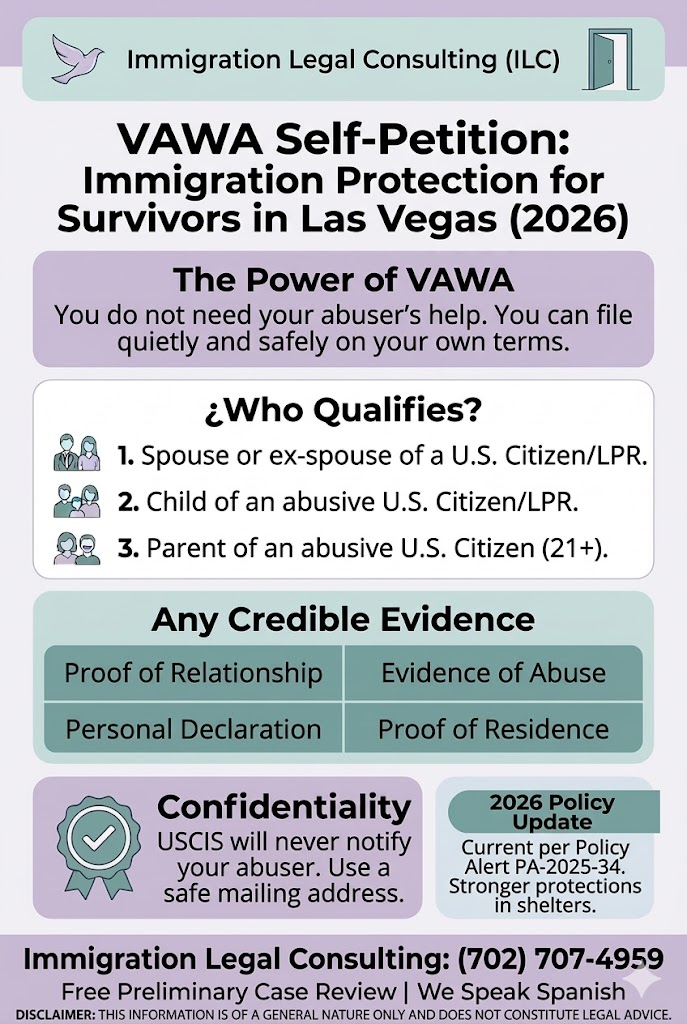
An infographic guide for survivors in Las Vegas on the VAWA self-petition process for 2026, outlining eligibility for spouses, children, and parents of abusive U.S. citizens or LPRs, and emphasizing the confidentiality of the USCIS application process.

Why Does This Matter in Las Vegas?

Nevada is one of the most affected states in the country for domestic violence. In fact, Nevada ranks second nationally for rates of intimate partner violence. In 2025 alone, 45 people died in domestic violence-related homicides in Nevada — and most of those cases occurred right here in Clark County, which includes Las Vegas.

For immigrant families, the fear runs even deeper. Additionally, Nevada has the highest share of unauthorized immigrant households in the U.S., at 9%. Many of these women believe they cannot seek help because of their immigration status.

Abusers often use immigration status as a tool of control. They threaten deportation to keep their partners silent. However, the law was designed to stop exactly that.​

What Is a VAWA Self-Petition?

The Violence Against Women Act (VAWA) is a federal law. Among other protections, it lets certain immigrant survivors petition for their own immigration status — without relying on their abuser.

You file the self-petition using Form I-360 with U.S. Citizenship and Immigration Services (USCIS). USCIS then reviews your case privately. Your abuser is never notified.

It is also worth noting that VAWA protects both women and men, regardless of gender.

Who May Qualify for a VAWA Self-Petition in Nevada?

Qualifying Relationships

You may be eligible to file a VAWA self-petition in Las Vegas if you are:

  • The spouse or former spouse of an abusive U.S. citizen or Lawful Permanent Resident (LPR/green card holder)
  • The child of an abusive U.S. citizen or LPR (generally under 21 and unmarried)
  • The parent of an abusive U.S. citizen son or daughter who is 21 or older

What You Must Generally Demonstrate

To file a VAWA self-petition, you will generally need to show:

1. A qualifying relationship

You are or were a spouse, child, or parent of a U.S. citizen or LPR.

2. Battery or extreme cruelty

You experienced abuse (physical, emotional, psychological, sexual, or financial abuse may all qualify).

3. Shared residence

You lived in the same home as your abuser at some point.

4. Good moral character

Typically shown through a police clearance and your personal declaration.

5. Current U.S. residence

You are living in the United States.

Is a VAWA Self-Petition Confidential?

Yes — federal law includes strong protections for VAWA applicants. Specifically, USCIS is prohibited from sharing information about your case with your abuser.

Furthermore, immigration enforcement is generally limited at domestic violence shelters, rape crisis centers, and victim services programs. In December 2025, USCIS reaffirmed these protections with a new policy update (Policy Alert PA-2025-34).

When you mail your I-360, you may use a safe address — a shelter, a trusted friend, or your attorney’s office — instead of your home address.​

What Documents Will You Generally Need?

The standard of proof under VAWA is “any credible evidence.” That means USCIS must consider all credible evidence you submit — even if you don’t have police reports or court records.

Documents About the Relationship

Marriage certificates, proof of the abuser’s status, joint leases, or family photos.

Evidence of Abuse

Medical records, photos of injuries, orders of protection, or statements from domestic violence counselors.

Your Personal Declaration

A powerful, detailed written statement describing the relationship and specific incidents of abuse.

What Are the General Steps of the VAWA Process?

1. Gather Your Evidence

Work with an attorney to organize documents and write your personal declaration (1–2 months).

2. File Form I-360

Submit your petition to the USCIS Vermont Service Center.

3. Prima Facie Determination (3–9 Months)

A preliminary finding that your evidence is credible, which can help you access certain public benefits.

4. Full Review and Decision

USCIS conducts a final review. As of 2026, processing times average approximately 46.5 months.

5. Path to a Green Card

After approval, you may apply for a green card (adjustment of status) using Form I-485.

6. Work Authorization

You may apply for work authorization (category C31) after approval.

5 Mistakes That Can Hurt a VAWA Case

1. Filing without legal guidance

Detailed declarations are required to meet strict legal standards.

2. Insufficient proof of abuse

Corroborating evidence is key to a strong case.

3. Missing the two-year post-divorce deadline

You must file within two years of a divorce from an abusive spouse.

4. Using an unsafe mailing address

Risks interception by the abuser.

5. Waiting too long

Delaying can limit your legal options and safety.

You Don't Have to Face This Alone in Las Vegas

In Las Vegas, the Legal Aid Center of Southern Nevada provides direct VAWA petition help at 702-386-1070. Nationally, the National Domestic Violence Hotline is available at 1-800-799-7233.

At Immigration Legal Consulting (ILC), Attorney Shaina Plaksin is dedicated to helping immigrant families in Las Vegas with compassion and clarity.

Not Sure If You’re Ready to Talk to a Lawyer Yet?

Get a Free Preliminary Immigration Case Review

Before committing to legal advice, this free review helps you see the landscape—how situations like yours are generally viewed, what processes and forms are commonly involved, and where cases often run into trouble.

It gives you the context and clarity to decide whether and when speaking with a lawyer makes sense.

  • ✅ No legal advice.
  • ✅ No pressure.
  • ✅ Just a clear, high-level roadmap.

For informational purposes only. No attorney-client relationship is created.

Contacting the firm by phone, email, or website does not create an attorney-client relationship. Do not send confidential information until a written representation agreement is signed. The firm is licensed only where stated (e.g., Nevada and California).

Leave a Reply

Your email address will not be published. Required fields are marked *