Removing Conditions on Your Green Card (I 751) in Las Vegas: What Families Should Know

Removing conditions on your green card is the step many Las Vegas couples must complete after receiving a 2‑year conditional marriage green card. In a time that should feel stable—raising kids, building credit, and buying a home in Nevada—this requirement can cause stress for many families.

You deserve clear and calm information. This guide explains Form I‑751, sample evidence, waiver options, and what to expect from USCIS. It is designed to help you protect your family’s future in Las Vegas, Henderson, and across Clark County.

Disclaimer: This article provides general educational information, not legal advice. Every immigration case is different, and reading this post does not create an attorney‑client relationship. Do not send confidential details until you have a signed representation agreement with a licensed attorney. For guidance about your specific situation, consult a qualified immigration attorney.

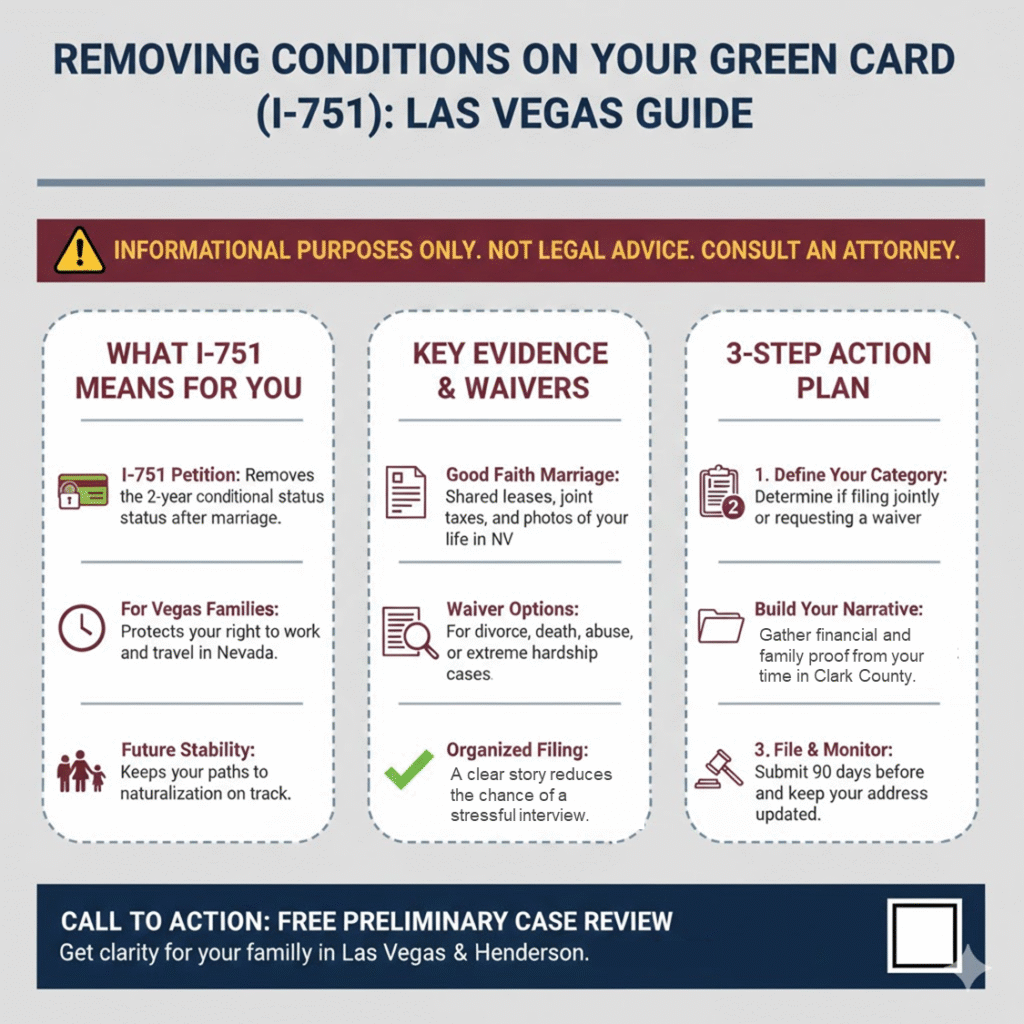
An infographic guide explaining the I-751 petition process for removing green card conditions for residents in Las Vegas and Henderson.

How this guide helps Las Vegas families

This article focuses on removing conditions on your green card for people living in Las Vegas, Henderson, and the rest of Clark County. It breaks the I‑751 process into short, clear sections so you can find the part that matches your situation.

What “Removing Conditions” Means in Nevada

Why USCIS requires Form I‑751

If you became a conditional permanent resident through marriage, USCIS usually requires you to file Form I‑751 to ask that the conditions be removed from your residence. The conditional status exists so USCIS can confirm that the marriage was entered in good faith and not only for an immigration benefit.

Why this step feels stressful

For families in Las Vegas or North Las Vegas, removing conditions on your green card is more than a form. Your ability to work and travel depends on keeping your status documented, and it affects your long‑term plan for naturalization. It can also be stressful when your paperwork is not perfect. Many couples have separate bank accounts or spend time living apart for work.

How it fits into your overall plan

It helps to view this filing as part of a larger plan, not just a single deadline. If you want to understand how this step fits into the bigger marriage‑based process in Nevada, you can also review our marriage green card timeline resources.

When to File Form I‑751 in Las Vegas

The 90‑day filing window

In most marriage‑based cases, you must file Form I‑751 during the 90 days before the second anniversary of the date you became a conditional resident. You can usually find this date on the front of your 2‑year green card next to the expiration date.

What happens if you file late

If you do not file before your card expires, your conditional resident status may end and you may be placed in removal proceedings. In some situations USCIS may excuse a late filing if you submit a written explanation and ask them to accept the petition after the deadline.

Key I‑751 filing tips for Nevada families

Mark the expiration date of your conditional green card as soon as you receive it, then plan backward so you can prepare your I‑751 packet early. Put reminder alerts in your phone or calendar so the 90‑day window does not sneak up on you. If you have gone through separation, divorce, or safety concerns, your filing category may change, so it is wise to talk to a professional before you submit anything.

After you submit the form

After USCIS receives your I‑751, you will usually get a biometrics notice. Las Vegas and Henderson families should keep addresses updated with USCIS so they do not miss this letter. For couples still comparing visa options, our K‑1 vs. CR‑1 guide for Las Vegas can also be helpful.

Evidence of a Good‑Faith Marriage for I‑751

What USCIS wants to see

When you are removing conditions on your green card, USCIS expects proof that you and your spouse built a real life together. The strongest I‑751 packets show a shared history in many areas and do much more than rely on photos from the wedding day.

How to organize your evidence

Try to group your documents in a way that tells a clear, simple story. Many families organize items by year or by type, then add a short cover letter that explains anything unusual, such as time living apart for work.

Types of evidence USCIS likes

Common evidence categories include:

  • Home life: Leases, mortgage statements, property tax records, or mail that shows both spouses at the same Nevada address over time.

  • Financial integration: Joint tax returns, shared bank or credit card statements, insurance policies with both names, or major joint purchases such as cars or furniture.

  • Family life: Birth certificates of children, school or medical records, and photographs that show your relationship over the years rather than at one event.

  • Community life in Nevada: Letters or affidavits from friends or community members, plus records of shared memberships or activities in local organizations, churches, or clubs.

A simple example packet

For example, a couple might send a lease from 2022, joint tax returns from 2023 and 2024, and photos with family at birthdays and holidays. Together, these items tell a simple story. Many homes in the Las Vegas valley have shift work, several jobs, or multigenerational living. A short cover letter that explains your situation can help the officer understand your story. A clear table of contents also makes the packet easier to review.

If you want more detail on acceptable evidence, you can review the official I‑751 instructions on government sites.

I‑751 Waivers When the Marriage Changed

When you cannot file jointly

Many conditional residents worry they cannot remove conditions on a green card if the marriage ended or changed. USCIS lets some people request a waiver of the joint filing rule, but only in specific situations.

Main waiver categories

You may qualify for an I‑751 waiver if:

  • You entered the marriage in good faith, but it ended in divorce or annulment.

  • You entered the marriage in good faith, but your spouse died.

  • You or your child experienced battery or extreme cruelty by your U.S. citizen or resident spouse.

  • Ending your status would cause you extreme hardship.

Why strategy and proof matter

Because of these different options, it is important to choose the right box on the form. These cases often need extra documentation, and you may have to file without your spouse’s signature. Many people in this situation prefer to get legal advice before filing. If your relationship is complicated, a confidential consultation with an immigration lawyer in Las Vegas or Henderson can help you choose the correct waiver category and strategy.

What Happens After You File I‑751

Your receipt notice and extension

After you file Form I‑751, USCIS will send you a receipt notice that extends your conditional resident status while your case is under review. The notice will list how long the extension lasts, and you will use it together with your expired green card as proof of status.

What to expect during processing

USCIS may take many months to decide your case. During that time, keep copies of everything you send and every notice you receive. This file can help later if you apply for naturalization.

Work, travel, and interviews

Some I‑751 cases are approved based only on the documents, while others are scheduled for an in‑person interview at a local USCIS office. Clear, well‑organized evidence can reduce the chance of a stressful interview. If your I‑751 is filed correctly and your receipt notice is still valid, you can usually continue to work and travel using your expired card plus the original I‑751 receipt.

Checking processing times

I‑751 processing times change often, so you should check current USCIS tools before you plan long international trips or major life changes. To confirm you are using the current form and rules, review the official I‑751 overview and instructions on government sites.

A Simple 3‑Step Plan for Las Vegas Families

How to put this into action

You can make removing conditions on your green card easier by breaking it into three steps.

  1. Define your category. Decide whether you will file jointly with your spouse or request a waiver based on divorce, death, abuse, or hardship, and then find your 90‑day filing window using the card’s expiration date.
  2. Build your narrative. Gather documents that show your shared life in Nevada—housing, finances, family, and community—and organize them with labels so an officer can follow your story quickly. For example, you can group items by year or by type of evidence.
  3. File and monitor. Submit your I‑751 packet following the official instructions, attend your biometrics appointment, and respond quickly if USCIS sends a Request for Evidence (RFE). In addition, keep your mailing address and email updated so you receive every notice.

If you want to see how I‑751 fits into the bigger process, you can review our K‑1 vs. CR‑1 guide. You can also read our Nevada marriage green card timelines.

Not Sure If You’re Ready to Talk to a Lawyer Yet?

Get a Free Preliminary Immigration Case Review

Before committing to legal advice, this free review helps you see the landscape—how situations like yours are generally viewed, what processes and forms are commonly involved, and where cases often run into trouble.

It gives you the context and clarity to decide whether and when speaking with a lawyer makes sense.

  • ✅ No legal advice.
  • ✅ No pressure.
  • ✅ Just a clear, high-level roadmap.

For informational purposes only. No attorney-client relationship is created.

Helpful links

Contacting the firm by phone, email, or website does not create an attorney-client relationship. Do not send confidential information until a written representation agreement is signed. The firm is licensed only where stated (e.g., Nevada and California).

Leave a Reply

Your email address will not be published. Required fields are marked *