Naturalization Guide for Nevada Families: Path to U.S. Citizenship
You have a green card, a home in Nevada, and a dream of becoming a U.S. citizen. At the same time, the process can feel confusing and risky. You may wonder if you qualify, how the tests work, or what happens if you make a mistake on your application.
This naturalization guide for Nevada families explains the path to U.S. citizenship in simple steps. You will learn basic eligibility rules, what Form N‑400 does, what to expect at the interview, and how to avoid common delays.
Disclaimer (informational only / not legal advice / no attorney client relationship)
This article provides general information about U.S. naturalization and should not be considered legal advice. Every immigration case is unique and depends on individual facts and circumstances. For advice about your specific situation, consult a licensed immigration attorney. Reading this content does not create an attorney‑client relationship.
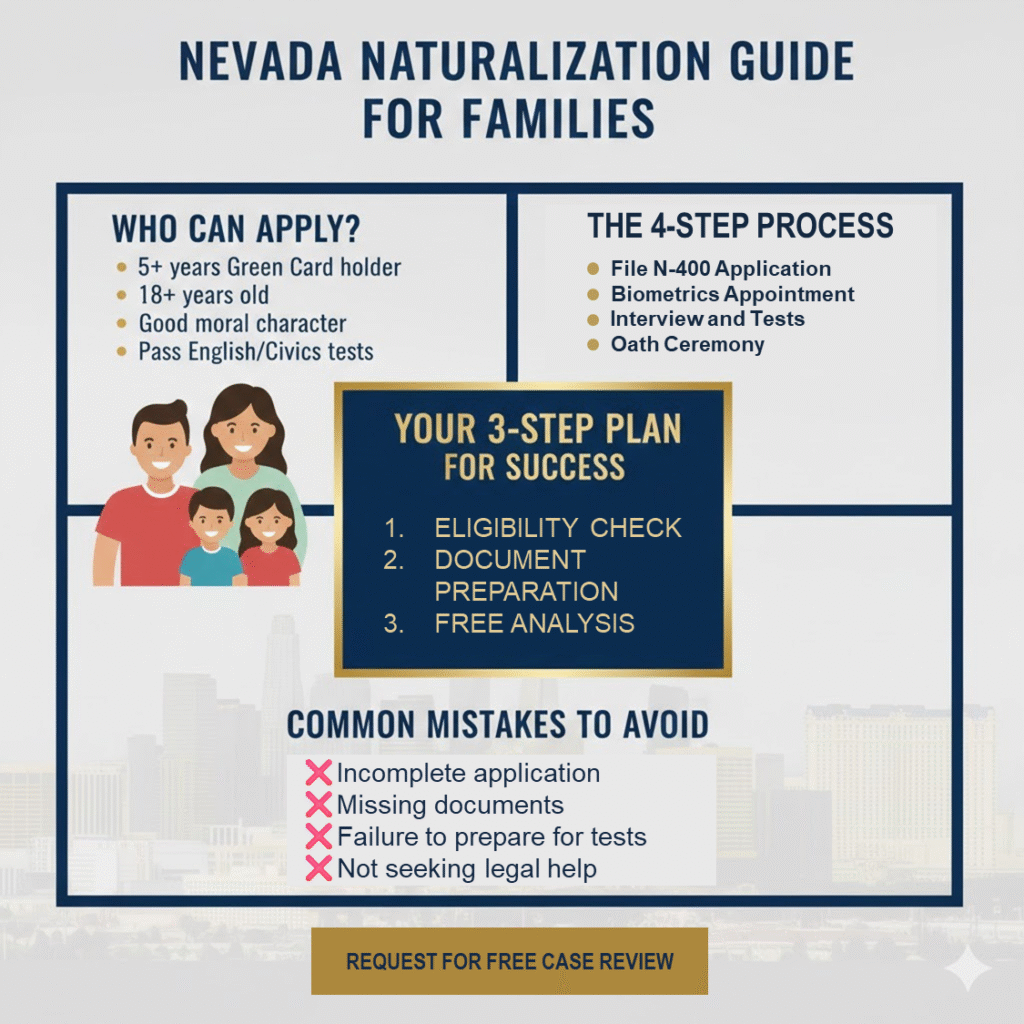
Naturalization guide for Nevada families: who can apply?
Basic time rules
Most Nevada green card holders qualify under one of these rules:
Five‑year rule: You have been a lawful permanent resident for at least five years.
Three‑year rule for spouses: You have been a lawful permanent resident for at least three years, and you meet specific marriage‑based requirements with a U.S. citizen spouse.
Military service: Some current or former service members may qualify under special rules after certain periods of service and residence.
In addition, you usually must have lived in Nevada (or within the same USCIS district) for at least three months before you file.
Continuous residence and physical presence
USCIS also looks at your time inside and outside the United States. You usually must:
Maintain continuous residence in the U.S. for the full three‑ or five‑year period.
Show physical presence in the U.S. for at least half of that time.
Long trips outside the country can break continuous residence or reduce physical presence. If you took trips longer than six months, it is wise to talk with an attorney before filing.
Good moral character
Another key requirement is “good moral character.” USCIS reviews your behavior during the three‑ or five‑year period, and sometimes longer. Problems like serious crimes, fraud, unpaid taxes, or failure to support dependents may cause issues. Because this area is complex, many Nevada families benefit from a legal review before applying.
How does the N‑400 process work?
Overview of the N‑400 steps
Step 1: Prepare and file Form N‑400
First, gather your documents. These often include your green card, passports, travel dates, marriage records, and tax returns. Then you complete Form N‑400 online or on paper. You answer questions about your history, travel, employment, and any criminal or immigration issues. You also pay the filing fee unless you qualify for a fee waiver.
Step 2: Biometrics appointment
Next, USCIS usually schedules a biometrics appointment. At this visit, you provide fingerprints and a photo so the government can run background checks. This step often takes only a short time but is required for most applicants.
Step 3: Interview and tests
After biometrics, you receive an interview notice for your local USCIS office, often in or near Las Vegas. At the interview, an officer:
Reviews your N‑400 answers.
Asks about your background and travels.
Gives you the English and civics tests, unless you qualify for an exception.
If the officer needs more documents, you may get a written request with a deadline.
Step 4: Oath of Allegiance
If your case is approved, you will be scheduled for an oath ceremony. At the ceremony, you return your green card, take the Oath of Allegiance, and receive your Certificate of Naturalization. From that moment, you are a U.S. citizen.
What should Nevada families know about the English and civics tests?
Most applicants must pass two tests:
English test: A speaking, reading, and writing evaluation during your interview.
Civics test: Questions about U.S. history and government.
USCIS publishes official study materials, including vocabulary lists, reading and writing samples, and all potential civics questions. Many community centers and libraries in Las Vegas and Henderson also offer citizenship classes. Because the test format is evolving, it is important to use up‑to‑date materials when you study.
Are there any exemptions or special accommodations?
Yes. U.S. law allows some exceptions, especially for older applicants and those with certain disabilities. For example:
Some long‑term residents who are age 50 or 55 and above may be excused from the English test and may take the civics test in their own language with an interpreter.
Some applicants age 65 and older with long residence may receive a simplified civics test.
Applicants with qualifying physical or mental disabilities may ask for exemptions or accommodations using a special medical form.
These options have detailed rules and require strong evidence. If you think you might qualify, it is usually best to get legal advice before you rely on an exception.
Common mistakes that delay naturalization
Mistakes Nevada families can easily avoid
Many delays and denials come from simple, avoidable mistakes, such as:
Filing too early and not yet meeting residence rules.
Forgetting to list trips, addresses, or employers.
Failing to mention arrests, citations, or dismissed charges.
Leaving questions blank or guessing at answers.
Not addressing past tax debts or support issues before filing.
Checking everything twice—and getting a legal review when you have doubts—can save months of stress.
Three‑step plan for your Nevada naturalization journey
Moving from plan to action
You are the hero in this story. Your goal is to protect your family’s future and fully belong in the place you now call home. A clear plan makes that much easier.
Clarify your eligibility date. Count your years as a green card holder, review your trips outside the U.S., and confirm that you meet Nevada’s local residence requirement.
Organize documents and prepare Form N‑400. Collect identity, travel, tax, and court records. Then complete the N‑400 carefully, following each instruction and answering truthfully.
Schedule a Free Preliminary Immigration Case Review (Free Analysis). Talk with a Nevada immigration attorney about your goals, your timeline, and any risk factors. A short conversation can help you avoid problems and walk into your interview with confidence.
Not Sure If You’re Ready to Talk to a Lawyer Yet?
Get a Free Preliminary Immigration Case Review
Before committing to legal advice, this free review helps you see the landscape—how situations like yours are generally viewed, what processes and forms are commonly involved, and where cases often run into trouble.
It gives you the context and clarity to decide whether and when speaking with a lawyer makes sense.
- ✅ No legal advice.
- ✅ No pressure.
- ✅ Just a clear, high-level roadmap.
For informational purposes only. No attorney-client relationship is created.
Contacting the firm by phone, email, or website does not create an attorney-client relationship. Do not send confidential information until a written representation agreement is signed. The firm is licensed only where stated (e.g., Nevada and California).