
Affidavit of Support I‑864 Income Requirements 2026 for Nevada Sponsors
If you are sponsoring a family member in 2026, you must understand the Affidavit of Support I‑864 income requirements 2026. Many Nevada sponsors in Las Vegas and Henderson feel nervous about the numbers. You may worry that you do not earn enough or that you will make a mistake on the form. The Affidavit of Support is not only paperwork. It is a legal contract where you promise to support your relative financially.
Because of that, it is important to break the process into simple steps. This guide explains the rules in plain English. It also shows how you can ask for legal help before you file.
Disclaimer (general information / not legal advice / no attorney‑client relationship)
This article provides general information about Affidavit of Support (Form I‑864) income requirements and should not be considered legal advice. Immigration law is complex, and every case is unique and depends on individual facts and circumstances. For advice about your specific situation, consult a licensed immigration attorney in your state. Reading this content does not create an attorney‑client relationship.
What is the Affidavit of Support (I‑864)?
The Affidavit of Support is a form that a sponsor signs to accept financial responsibility for certain immigrants. The sponsor is usually the person who filed the family‑based petition, such as a spouse, parent, or adult child. By signing this form, the sponsor promises to help the immigrant keep a basic income level and avoid relying mainly on certain need‑based public benefits.
How long does the obligation last?
The duty can last for many years. In most cases, it ends only when:
The immigrant becomes a U.S. citizen.
The immigrant works about 10 years in the United States under Social Security rules.
The immigrant leaves the U.S. for good.
Either the sponsor or the immigrant dies.
Because this obligation is long‑term, Nevada sponsors should understand both the legal effect and the Affidavit of Support I‑864 income requirements 2026 before signing anything.
How do the income requirements work in 2026?
125% vs 100% of the poverty guidelines
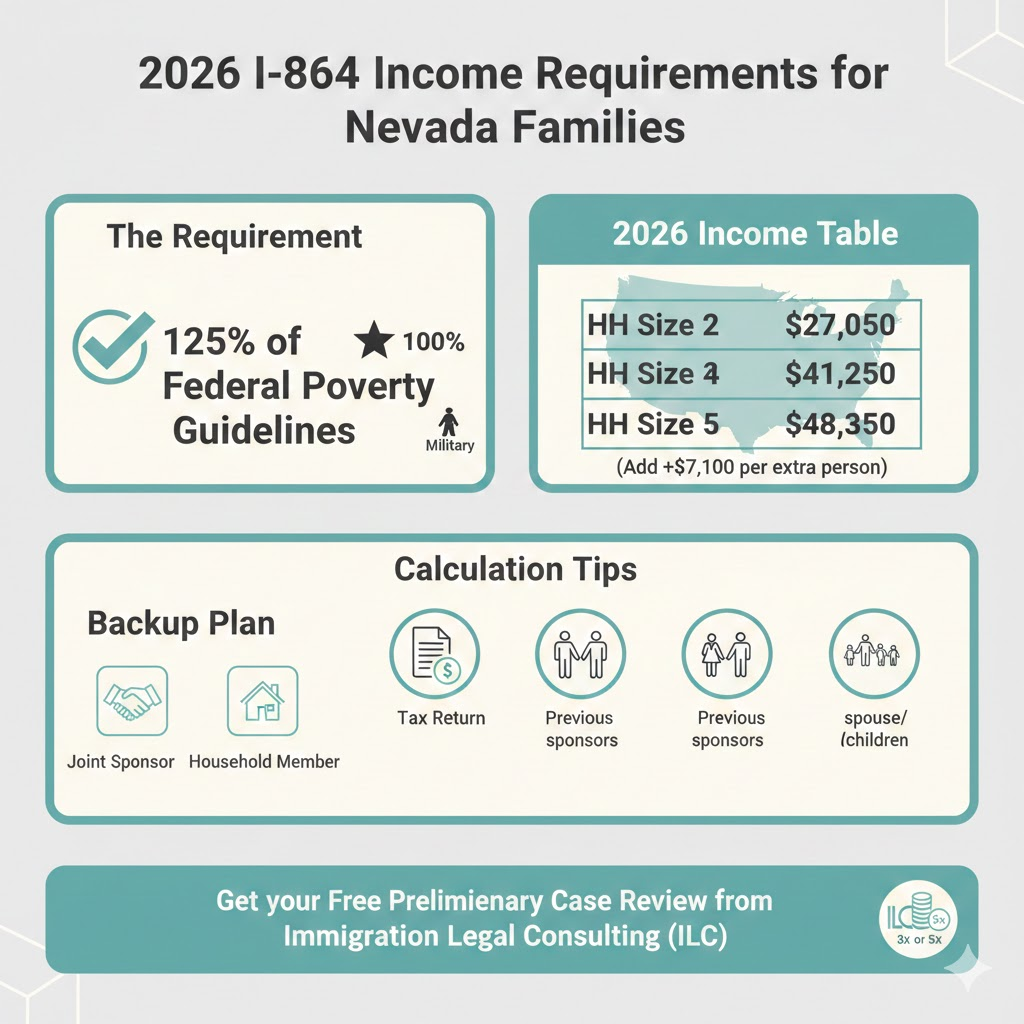
First, the required income is tied to the Federal Poverty Guidelines. In many family‑based cases, the sponsor must show household income at 125% of the Federal Poverty Guidelines for the correct household size. However, if the sponsor is on active duty in the U.S. armed forces and is sponsoring a spouse or unmarried child, the required income may be 100% of the guideline instead.
Who sets the numbers?
Each year, the Department of Health and Human Services (HHS) updates the poverty guidelines. After that, USCIS uses these guidelines to publish a chart with specific amounts for sponsors on Form I‑864P. For 2026, Nevada sponsors use the chart for the 48 contiguous states. As your household size goes up, the income you must show under the Affidavit of Support I‑864 income requirements 2026 also goes up.
Example 2026 amounts (Nevada / 48 states)
The exact numbers can change, so always confirm them on the latest USCIS chart. As a rough example for 2026:
A household of 2 needs income in the mid‑$27,000 range at 125%.
A household of 3 needs income in the mid‑$34,000 range.
A household of 4 needs income in the low‑$41,000 range.
A household of 5 needs income in the high‑$48,000 range.
These figures are only estimates. Before you file, you should verify the current chart on USCIS.gov.
How do you count your household size?
Why household size matters
Household size is a key part of the calculation. A bigger household means a higher income requirement. If you miscount your household, you may think you qualify when you do not, or you may think you do not qualify when you actually do. That is why this step deserves extra attention.
Who is usually included?
For many sponsors, household size includes:
You, the sponsor.
Your spouse.
Your unmarried children under 21 who live with you.
Anyone you claimed as a dependent on your most recent federal tax return.
Any immigrants you previously sponsored who are still covered by your old I‑864.
The immigrant you are now sponsoring and any qualifying family members coming with them.
Simple example for Las Vegas families
Imagine a U.S. citizen in Las Vegas who sponsors a spouse and one child and has no other dependents. That is usually a household of three. If that sponsor also claimed a parent as a dependent on last year’s tax return, the household size becomes four. That change increases the minimum income needed to meet the Affidavit of Support I‑864 income requirements 2026.
What income and assets can you use?
Income sources
USCIS looks at your expected income for the year when you sign the Affidavit of Support. To prove this income, you usually submit:
Your most recent federal tax return.
W‑2s or 1099s.
Recent pay stubs or an employment letter.
Common income sources that may count include wages, salary, self‑employment income, retirement income, and some disability or pension payments. In contrast, one‑time lottery winnings or income from illegal activity generally do not count.
Using assets to fill a gap
If your income alone does not reach the line set by the Affidavit of Support I‑864 income requirements 2026, you may be able to use assets. Assets can include:
Cash in checking and savings accounts.
Certificates of deposit, stocks, or bonds.
Equity in a house or other real estate (value minus what you owe).
To use assets, the total net value usually must be several times larger than the amount of income you are missing. For example, if you are short by $5,000, you may need assets worth $15,000 to $25,000, depending on who you are sponsoring.
What if your income does not meet the line?
Joint sponsors
If your income is not enough, you still may have options. One common solution is to use a joint sponsor. A joint sponsor files their own Form I‑864 and takes on the same legal obligations as you. The joint sponsor must:
Be a U.S. citizen or lawful permanent resident.
Be at least 18 years old.
Be domiciled in the United States.
Independently meet the income requirement for their own household size.
A joint sponsor can live anywhere in the United States, not just in Nevada. Many families in Las Vegas ask a close relative or trusted friend who has stable income to act as a joint sponsor.
Household members who help with income
Another option is to count income from certain household members. A working spouse, parent, or adult child who lives with you may be able to combine their income with yours. To do this correctly, that person usually must:
Sign a separate contract form.
Provide their own tax returns and pay stubs.
Simply attaching their pay stubs without the correct form is not enough and may lead to delays.
Common Affidavit of Support mistakes to avoid
Even careful sponsors in Nevada can make mistakes. Knowing the most frequent problems can help you avoid them:
Using old poverty‑guideline charts instead of the 2026 numbers.
Miscounting household size by forgetting dependents or past beneficiaries.
Leaving questions blank or forgetting to sign the I‑864.
Relying on an old high‑income tax return when current income is lower.
Assuming the I‑864 obligation ends as soon as the green card is approved.
Any of these issues can cause Requests for Evidence, rescheduled interviews, or even denials. Therefore, taking time to understand the Affidavit of Support I‑864 income requirements 2026 and reviewing your packet carefully can protect your case.
Three‑step plan for Nevada sponsors
To simplify everything, consider this three‑step plan:
Confirm your numbers.
Identify your correct household size and look up the current 2026 poverty‑guideline chart used for the Affidavit of Support I‑864 income requirements 2026.Review your income and backup options.
Compare your income to the required amount. If there is a gap, think about a joint sponsor, income from qualified household members, or assets.Get a professional review.
Before sending anything to USCIS or the National Visa Center, ask an immigration attorney to review your Affidavit of Support packet. A short review now can prevent long delays later.
Conclusion: Understand the Affidavit of Support I‑864 income requirements 2026
The Affidavit of Support I‑864 income requirements 2026 are at the heart of many family‑based immigration cases in Nevada. Meeting the correct income level, counting your household size correctly, and using joint sponsors or assets in the right way can make your case stronger and reduce stress. Because this is a serious financial commitment, it is wise to understand the rules before you sign.
If you are a sponsor in Las Vegas, Henderson, or anywhere in Nevada and feel overwhelmed, clear information and a simple plan can help you protect your family and move your loved one’s case forward.
Not Sure If You’re Ready to Talk to a Lawyer Yet?
Get a Free Preliminary Immigration Case Review
Before committing to legal advice, this free review helps you see the landscape—how situations like yours are generally viewed, what processes and forms are commonly involved, and where cases often run into trouble.
It gives you the context and clarity to decide whether and when speaking with a lawyer makes sense.
- ✅ No legal advice.
- ✅ No pressure.
- ✅ Just a clear, high-level roadmap.
For informational purposes only. No attorney-client relationship is created.
Contacting the firm by phone, email, or website does not create an attorney-client relationship. Do not send confidential information until a written representation agreement is signed. The firm is licensed only where stated (e.g., Nevada and California).