Affidavit of Support (I-864) Income Requirements in 2026: What Sponsors Need to Know in Las Vegas
If you are helping a family member get a green card in Las Vegas, Nevada, the Affidavit of Support (Form I‑864) can feel confusing and stressful. The income rules in 2026 still depend on the federal poverty guidelines, and even a small mistake may delay the case for months. This guide explains the main I‑864 income requirements in simple language so that families in Las Vegas, Henderson, and across Nevada can feel more prepared before they talk with an immigration attorney.
General information / not legal advice
This article provides general information about Affidavit of Support (Form I‑864) income requirements in 2026 and should not be construed as legal advice. Immigration law is complex, and every case is unique and depends on individual facts and circumstances. For advice specific to your situation, consult a licensed immigration attorney. Reading this content does not create an attorney‑client relationship.
What is the Affidavit of Support (I‑864) and why is it important?
Picture a mixed‑status family in Las Vegas. You are a U.S. citizen. Your spouse or parent is waiting for a green card. You worry that one missing document could separate your family.
The Affidavit of Support is the contract you sign with the U.S. government. In that contract, you promise that your loved one will not rely on certain government cash benefits to survive. As a result, the I‑864 becomes a key part of proving that the sponsored relative has financial support.
In 2026, most family‑based green card cases require Form I‑864, and some employment‑based cases with a family sponsor do as well. The sponsor must be a U.S. citizen or lawful permanent resident, at least 18, and “domiciled” in the United States. Because of this, many Las Vegas families see the I‑864 as the part of the process where the pressure is highest.
How do the 2026 poverty guidelines and the 125% rule work?
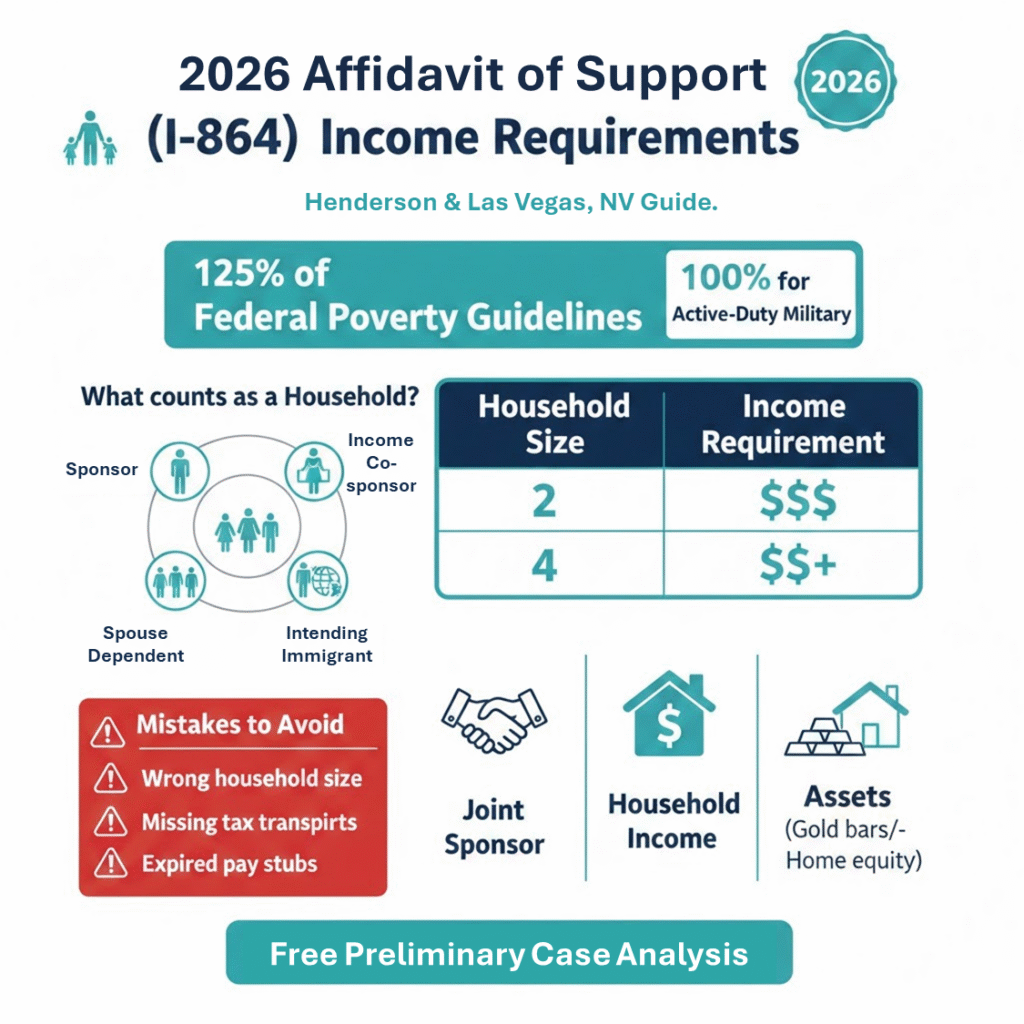
In 2026, most I‑864 sponsors must show income that is at least 125% of the Federal Poverty Guidelines for their household size. The Department of Health and Human Services updates these guidelines every year, and the new 2026 figures appear in an official Federal Register notice. Immigration agencies then use these figures for Affidavit of Support cases.
For sponsors in Nevada, the important points are:
The government sets a 100% poverty line, and the I‑864 usually requires 125% of that amount.
Certain active‑duty U.S. military sponsors for a spouse or child may only need to meet 100% of the guideline.
Alaska and Hawaii use higher amounts, but Las Vegas and Henderson follow the “48 states” chart.
Therefore, before you file, you should confirm the correct 2026 guideline and apply the 125% (or in some military cases 100%) figure to your household size. The Department of State notes that officers use the poverty guidelines in effect on the filing date of the Affidavit of Support to decide if the income requirement is met.
How should Las Vegas sponsors apply the 2026 numbers in real life?
In practice, this means you first calculate your household size, then look up the income line that matches that size on the 2026 chart for the 48 states. Next, you compare your current annual income to that line. If your income meets or exceeds that number, you generally satisfy the basic I‑864 income test.
If your income is slightly below the line, you may still have options. For example, a joint sponsor, household member income, or assets might help cover the gap. Because small errors can lead to delays, many Nevada families check these calculations with an immigration attorney before submitting the Affidavit of Support.
How do you count household size and income for Form I‑864?
Household size and income go together. If you miscount the number of people, you may think you do not qualify even when you do.
Who belongs in your household size?
For many I‑864 sponsors, household size includes:
-
You, the sponsor.
-
Your spouse, if you are married.
-
Any dependents you claim on your federal tax return.
-
The person or people you are sponsoring for a green card.
Sometimes prior sponsorships or additional relatives can change this number. Because of this, it is wise to double‑check the household size rules in the official instructions or with a lawyer before you file.
What income usually counts?
USCIS focuses mainly on current, ongoing income, not just last year’s tax return. You normally rely on:
-
Salary or hourly wages, backed up by recent pay stubs and an employer letter.
-
Self‑employment income shown on tax returns and basic business records.
-
Regular retirement, pension, or disability benefits with proof.
-
In some cases, income from qualifying household members who agree to be included.
For example, you may have started a new job in Las Vegas with higher pay. In that situation, strong current pay stubs and an employer letter can help show that you now meet the guideline even if last year’s tax return shows a lower amount.
What can you do if your income seems too low in 2026?
Many sponsors panic when their income appears to fall below the line. However, the Department of State explains that petitioners who cannot meet the minimum income level can often use a joint sponsor or the income of a household member. In some cases, assets may also help.
Option 1: Add a joint sponsor
A joint sponsor is another U.S. citizen or green card holder who files a separate I‑864 and qualifies on their own. This person promises to support the immigrant as well.
Key points about joint sponsors:
-
The joint sponsor must independently meet the 125% guideline (or 100% for certain military cases) for their own household size plus the sponsored immigrant.
-
The original petitioner usually must still file an I‑864, even if a joint sponsor is involved.
Option 2: Use household member income
Sometimes another person in your home, such as a spouse or adult child, earns enough to close the gap. If they meet the requirements and agree, you may be able to count their income as well, often by using an additional I‑864‑series form. This option can make a big difference for families in Las Vegas where more than one person works.
Option 3: Use assets to cover the gap
If income is still too low, you may also rely on assets such as savings, stocks, or property equity. The Department of State explains that:
-
The net value of assets (after subtracting debts) must usually be at least five times the difference between your income and the 125% poverty guideline.
-
If you are sponsoring the spouse or child of a U.S. citizen, assets must usually equal at least three times that difference instead.
For instance, if you are $5,000 short of the required income and you sponsor your spouse, you may need at least $15,000 in qualifying assets to make up for the gap. Because asset rules are technical, many people ask a lawyer to review their plan before they rely heavily on this option.
What I‑864 mistakes commonly delay Las Vegas cases?
Most families are doing their best. Still, certain mistakes appear again and again. These errors often lead to Requests for Evidence (RFEs) or long waits.
Frequent problems include:
-
Miscounting household size and using the wrong income requirement.
-
Using the wrong year’s poverty guideline instead of the current 2026 chart.
-
Sending only old tax returns when current income has changed significantly.
-
Submitting weak income proof, such as missing employer letters or insufficient pay stubs.
-
Assuming a joint sponsor replaces the petitioner’s I‑864, instead of adding to it.
Fortunately, you can reduce these risks with a simple plan and an organized file.
A simple 3‑step plan for your family
To move from confusion to clarity, many families in Las Vegas and Henderson follow a straightforward 3‑step plan:
-
Clarify your numbers.
Confirm your household size, then compare your current income to the correct 2026 poverty guideline for that size. -
Choose a backup strategy if needed.
If your income alone is not enough, consider whether a joint sponsor, household member income, or assets can reasonably close the gap. -
Ask a Nevada immigration lawyer to review your I‑864 packet.
A review can help catch missing documents and reduce the chance of RFEs or unexpected delays.
Because the stakes are high—your family’s ability to live together in Nevada—taking these three steps can give you more control over the process.
What should you do next if you feel overwhelmed?
If you feel overwhelmed by the Affidavit of Support income rules in 2026, you are not alone. Many families in Las Vegas and Henderson worry that one mistake will stop a spouse or parent from getting a green card.
However, you do not have to guess. When you understand how household size, poverty guidelines, and proof of income fit together, you can make better decisions and prepare a stronger file. If you want to talk through your options in plain Spanish or English, you can request a Free Preliminary Immigration Case Review (Free Analysis) with a local immigration law firm.
Not Sure If You’re Ready to Talk to a Lawyer Yet?
Get a Free Preliminary Immigration Case Review
Before committing to legal advice, this free review helps you see the landscape—how situations like yours are generally viewed, what processes and forms are commonly involved, and where cases often run into trouble.
It gives you the context and clarity to decide whether and when speaking with a lawyer makes sense.
- ✅ No legal advice.
- ✅ No pressure.
- ✅ Just a clear, high-level roadmap.
For informational purposes only. No attorney-client relationship is created.
Contacting the firm by phone, email, or website does not create an attorney-client relationship. Do not send confidential information until a written representation agreement is signed. The firm is licensed only where stated (e.g., Nevada and California).
Additional Important Disclaimers
Current as of February 2026.Immigration law, USCIS forms, and poverty guidelines change often. Confirm current rules on USCIS.gov, travel.state.gov, or with an immigration attorney before filing.
Contacting a law firm through this blog, website, email, phone, or social media does not create an attorney‑client relationship. Do not send confidential information until a formal written agreement is signed. The firm is licensed only where stated (for example, Nevada and California).
Immigration decisions are made by USCIS or the Department
Sign Up for our FREE Newsletter:
Contact
-
8275 S. Eastern Ave., Suite 200
Las Vegas, NV 89123 - 702-707-4959
- 702immigration.com
Latests Posts
© 2021 Immigration Legal Consulting LLC. All rights reserved.
Attorney Advertising. This information is designed for general information only. The information presented should not be construed to be formal legal advice nor the formation of a lawyer/client relationship. Past results and testimonials are not a guarantee, warranty, or prediction of the outcome of your case, and should not be construed as such. Past results cannot guarantee future performance. Any result in a single case is not meant to create an expectation of similar results in future matters because each case involves many different factors, therefore, results will differ on a case-by-case basis. By providing certain contact information herein, you are expressly authorizing the recipient of this message to contact you via the methods of communication provided.