Child Visa Petition (I-130) in Nevada: Step by Step Guide for Las Vegas Parents in 2026
If you’re trying to bring your child to the United States, then you’re not just dealing with paperwork. In reality, you’re trying to keep your family together in Las Vegas, Nevada. As a result, a child visa petition Nevada case can feel heavy, emotional, and urgent.
However, the good news is this: the process usually follows a predictable path. First, you file Form I‑130. After that, your child may move forward through adjustment of status (in the U.S.) or consular processing (outside the U.S.).
Below is a step‑by‑step guide written specifically for Las Vegas and Henderson parents in 2026.
Disclaimer (general info only)
This article provides general information about a child visa petition (Form I‑130). It is not legal advice. Immigration law is complex, and every case is unique. Reading this article does not create an attorney‑client relationship. For advice about your situation, consult a licensed immigration attorney.
What is a child visa petition in Nevada (Form I 130)?
In most cases, a child visa petition in Nevada starts with Form I‑130, Petition for Alien Relative. Specifically, this form is used by U.S. citizens and lawful permanent residents to prove they have a qualifying family relationship with the relative they want to sponsor.
Importantly, each person you sponsor needs a separate Form I‑130. In addition, you can submit Form I‑130 online or by mail, depending on your situation and current USCIS instructions.
For this reason, Las Vegas parents should treat this step seriously. If USCIS says the relationship proof is not enough, then the whole case may slow down.
Which child category applies (IR‑2, CR‑2, or something else)?
This is one of the biggest points of confusion for parents. Essentially, the category depends on who you are (U.S. citizen or green card holder) and your child’s age and marital status.
Here’s a clear overview:
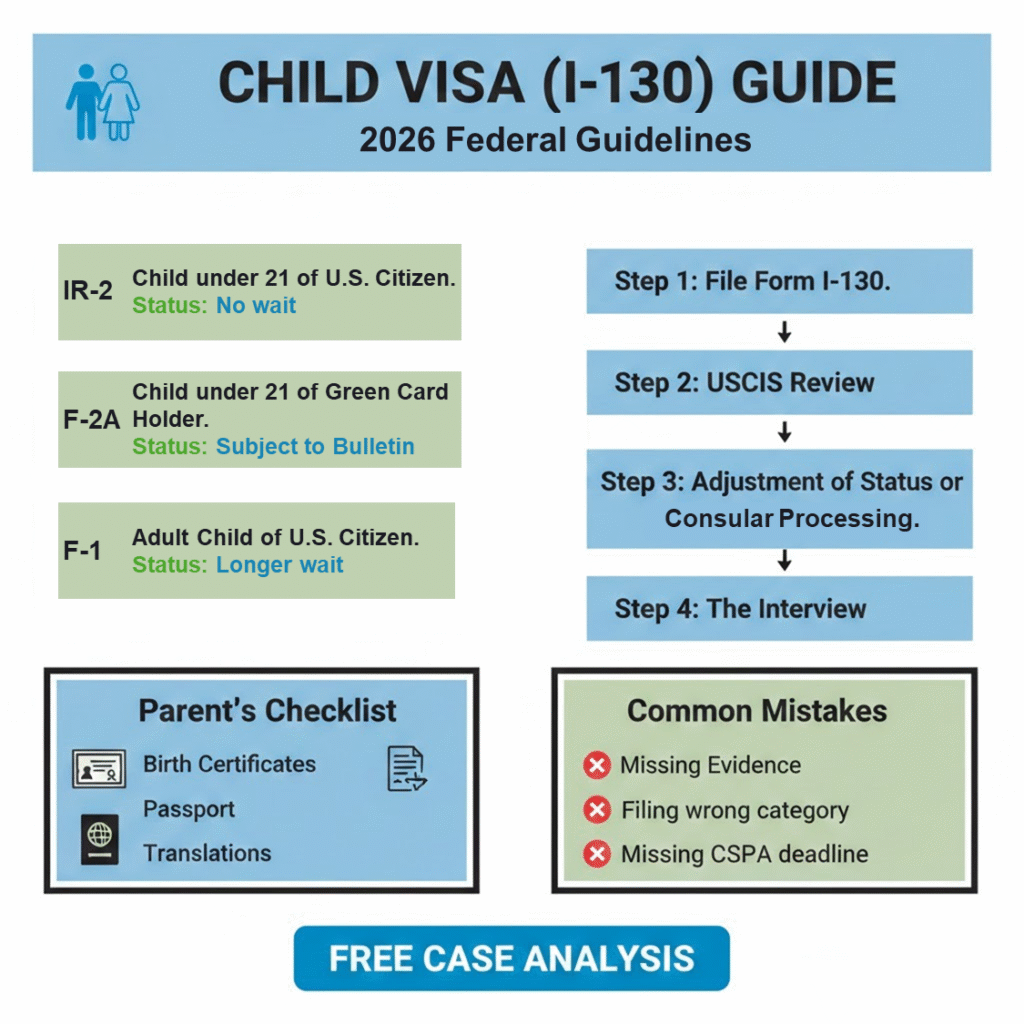
Category | Typical fit | Key detail |
IR‑2 | Unmarried child under 21 of a U.S. citizen | Immediate relative, no yearly visa limit wait |
CR‑2 | Unmarried child under 21 of a U.S. citizen | Similar to IR‑2 but “conditional” due to marriage-length rules |
F‑2A | Unmarried child under 21 of a green card holder | Visa bulletin wait may apply |
F‑1 | Unmarried adult child (21+) of a U.S. citizen | Longer visa bulletin waits are common |
Generally, most families follow the same big structure. Still, the details change based on whether your child is in the U.S. or abroad.
How do you file a child visa petition in Nevada step by step?
Most families follow the same big structure. Still, the details change based on whether your child is in the U.S. or abroad.
Step 1: Prepare and file Form I‑130
For most parents, filing Form I‑130 is the first step. Specifically, the Department of State describes this as Step 1 in the immigrant visa process for family cases.
You can file in two ways:
Online (electronically), or
By mail (paper filing).
To avoid delays, families usually prepare supporting documents that prove:
The parent’s U.S. citizenship or green card status
The parent‑child relationship (for example, a birth certificate, adoption documents, or step‑relationship proof)
Step 2: Wait for USCIS to process the petition
Without a doubt, this is the hardest part emotionally. It can feel like nothing is happening for months.
During this stage, USCIS may:
Approve the petition, or
Ask for more documents, or
Deny it (in some situations).
Because of the current environment, it helps to file a complete petition from the start. That way, you reduce the risk of slowdowns and repeat filings.
Furthermore, processing times vary. Always check USCIS processing time tools and case status tools for the most current information.
Step 3: Choose the next path — adjustment of status or consular processing
After I‑130 approval, your child usually goes down one of two routes. According to USA.gov, the overall process can involve things like NVC processing, fee payments, supporting documents, and interview preparation.
If your child is outside the U.S. (consular processing):
In most cases, these cases move through the National Visa Center (NVC) stage, then to a U.S. embassy or consulate for an interview.
If your child is in the U.S. (adjustment of status):
On the other hand, your child may be able to apply to adjust status (depending on eligibility and facts).
Because eligibility can be complicated, it’s smart to confirm the right route with an attorney before filing anything beyond the I‑130.
Step 4: Interview and final decision
Finally, many cases end with an interview (either with USCIS or at a U.S. consulate). If approved, your child may receive a green card (or an immigrant visa to enter the U.S. as a permanent resident), depending on the route.
What common mistakes delay a child visa petition in Las Vegas?
Most parents don’t make mistakes because they don’t care. Instead, they make mistakes because they’re rushing, scared, or trying to do everything alone.
Here are common delay triggers:
First, missing documents or unclear relationship proof (birth records, adoption papers, stepchild proof).
Second, filing the wrong category because the child’s age or marital status changed.
Third, filing by mail to the wrong place or using outdated filing instructions (this can cause rejection or delay).
Finally, not tracking the case status and missing a deadline to respond.
Consequently, this is exactly how families end up stuck in longer separations. In some cases, it can also create more costs later.
A simple 3‑step plan for Las Vegas parents
You want to wake up and make breakfast with your child in the same kitchen. Similarly, you want school drop‑offs in Henderson and birthdays together in Las Vegas. Above all, you want a process you can understand.
Here’s a simple plan:
1. Get clarity.
Confirm your category (IR‑2, CR‑2, F‑2A, or F‑1) and whether your child is in the U.S. or abroad, because the steps can differ.
2. File strong the first time.
File Form I‑130 with clear evidence of your status and the parent‑child relationship. Also, file it online or by mail using current instructions.
3. Get support before you guess.
Request a Free Analysis (Free Preliminary Immigration Case Review) so you can ask questions early, understand timelines, and avoid preventable delays.
Conclusion
In summary, a child visa petition in Nevada usually begins with Form I‑130. You can file it online or by mail, and you must file a separate I‑130 for each child you sponsor. After that, your child’s next steps depend on whether they are inside the U.S. or abroad. Furthermore, the process may include NVC processing, fees, supporting documents, and interview preparation.
If you want help understanding which category fits your child and what timeline is realistic for Las Vegas or Henderson, request a Free Analysis (Free Preliminary Immigration Case Review). Ultimately, you don’t have to do this alone.
Not Sure If You’re Ready to Talk to a Lawyer Yet?
Get a Free Preliminary Immigration Case Review
Before committing to legal advice, this free review helps you see the landscape—how situations like yours are generally viewed, what processes and forms are commonly involved, and where cases often run into trouble.
It gives you the context and clarity to decide whether and when speaking with a lawyer makes sense.
- ✅ No legal advice.
- ✅ No pressure.
- ✅ Just a clear, high-level roadmap.
For informational purposes only. No attorney-client relationship is created.
Contacting the firm by phone, email, or website does not create an attorney-client relationship. Do not send confidential information until a written representation agreement is signed. The firm is licensed only where stated (e.g., Nevada and California).