EB-4 Religious Worker Visa Category Expires January 30, 2026: What Las Vegas Faith Communities Need to Know
Las Vegas faith communities face an urgent disruption. The EB-4 “Certain Religious Workers” (often called the SR category) expires on January 30, 2026. This deadline creates immediate planning pressure for congregations across Clark County.
In practical terms, this expiration affects the religious worker serving your congregation. It also affects the worker’s spouse and children, who have built a life here in Nevada. If you lead a church, temple, mosque, synagogue, or faith-based nonprofit in Las Vegas, Henderson, or North Las Vegas, this deadline creates stress, confusion, and genuine fear of separation. Therefore, understanding your options now can prevent crisis decisions later.
The EB-4 “Certain Religious Workers (SR)” category expires on January 30, 2026. If your church or religious organization sponsors religious workers (not ministers), review your case immediately. Additionally, speak with an immigration attorney to evaluate your specific situation.
Disclaimer: This article provides general information, not legal advice. Reading it does not create an attorney-client relationship. Immigration options depend on specific facts, so talk with a licensed immigration attorney before acting.
What is the EB-4 “Certain Religious Worker (SR)” category?
EB-4 is a green card (permanent residence) category that includes “certain special immigrants.” The “certain religious workers” classification is a specific part of that fourth-preference group. Consequently, it serves non-minister religious workers who qualify for permanent residence based on their religious vocation or occupation.
The U.S. Department of State explains that immigrant religious worker cases fall under Employment Fourth Preference. These cases typically start with an I-360 petition filed with USCIS. Following approval, applicants proceed through consular processing or, in some cases, adjustment of status within the United States.
Crucially, a spouse and minor unmarried children under 21 may typically apply as derivatives with the principal religious worker. This family-based benefit makes the SR category particularly valuable for religious workers supporting families in Nevada.
Why is the SR category expiring on January 30, 2026?
The State Department’s Visa Bulletin for February 2026 indicates that H.R. 5371 extends the Employment Fourth Preference “Certain Religious Workers (SR)” category only until January 30, 2026. This represents a hard legislative deadline that cannot be extended administratively.
According to the bulletin, the following restrictions apply:
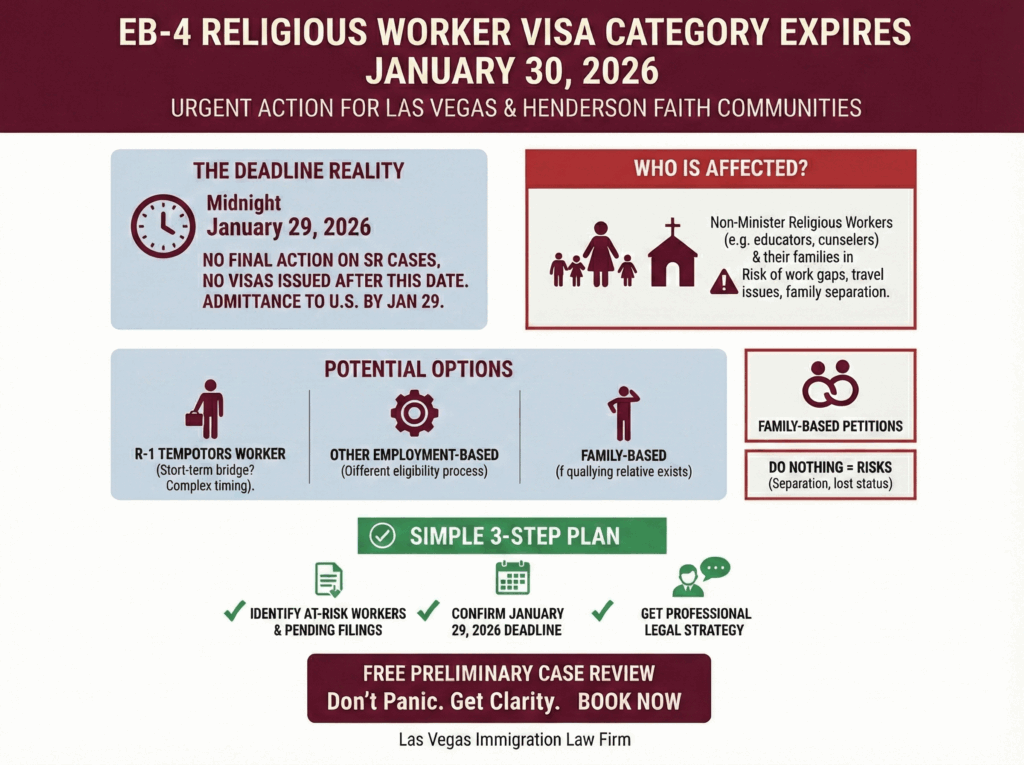
No SR visas may be issued overseas after midnight on January 29, 2026.
No final action may be taken on adjustment of status cases after midnight on January 29, 2026.
Visas issued before this date are valid only until January 29, 2026.
Individuals in the non-minister special immigrant category must be admitted to the United States no later than midnight on January 29, 2026.
For February, the Visa Bulletin lists “Certain Religious Workers” as “Unavailable” for all countries. However, it notes that the category could become available immediately if Congress passes legislative action to extend it. Therefore, staying informed about potential legislative changes remains important.
Who in Las Vegas and Henderson could be affected?
This expiration frequently impacts non-minister roles that keep faith communities running day-to-day. For example, these roles include religious education, outreach, counseling support, and community programs. This becomes especially critical when the worker supports a family here in Clark County.
If your organization employs someone in a religious vocation or occupation who is not classified as a “minister,” your case may be caught in this SR sunset window. In other words, the person leading your children’s programs, community outreach, or religious education may face status uncertainty.
Even if your congregation remains stable financially and spiritually, immigration paperwork can create a sudden “clock is ticking” moment that feels overwhelming. This is particularly true for Spanish-speaking families who may already feel unsure about future government actions. Consequently, early planning can reduce unnecessary stress and provide clarity.
What options may exist if your SR case can't be finalized in time?
Options depend heavily on the worker’s role, credentials, prior immigration history, and your organization’s structure. Consider these common pathways as possibilities to discuss with counsel, rather than a checklist for self-filing:
R-1 (Temporary Religious Worker)
Organizations sometimes use this option to keep religious work lawful while they evaluate longer-term plans. However, timing, eligibility, and maximum stay rules are critical factors. Additionally, R-1 status requires careful coordination to avoid gaps in work authorization.
Other Employment-Based Paths (EB-2/EB-3)
In some situations, these may be viable options. However, they can be complex and require steps that differ significantly from the EB-4 SR process. Therefore, professional evaluation of eligibility remains essential before pursuing these alternatives.
Family-Based Options
If the worker has a qualifying U.S. citizen or permanent resident relative, a separate family process may exist. For instance, immediate relatives of U.S. citizens often have more straightforward pathways. Nevertheless, processing times and eligibility requirements vary significantly.
"Do Nothing and Hope it Works Out"
This path most often leads to avoidable problems. Specifically, consequences include work authorization gaps, travel risks, or family separation. Consequently, proactive planning almost always produces better outcomes than waiting.
Because the Visa Bulletin describes a hard cutoff for SR final action after midnight January 29, 2026, many organizations should seek a legal review immediately. This review helps determine if a lawful “bridge” strategy is available.
A Simple 3-Step Plan for Your Organization
Here is a clear plan you can follow this week without guessing:
1. Identify who is at risk
Make a list of all sponsored religious workers (and their spouses/children). Then, note their current status and identify which filings are pending. This inventory helps you understand the scope of the deadline’s impact on your organization.
2. Confirm your deadline reality
If the case involves EB-4 “Certain Religious Workers (SR),” treat midnight January 29, 2026, as the urgent cutoff for final action described by the State Department. Therefore, assume you have days, not months, to act.
3. Get a professional legal strategy
Bring your documents to a qualified immigration attorney. They will evaluate options, risks, and backup plans based on facts—not fear. Additionally, professional guidance helps you avoid common mistakes that can derail cases.
Free Preliminary Immigration Case Review
If your Las Vegas or Henderson faith community sponsors a religious worker—or your family depends on that worker’s status—schedule a Free Preliminary Immigration Case Review. You will get clarity on what the January 30 deadline means for your specific situation. Furthermore, you’ll learn what options may still be available.
The Cost of Inaction
Without a plan, organizations can miss deadlines, rely on rumors, or make travel and work decisions that create unnecessary risk. This can sometimes lead to separation, lost status, or removal proceedings. Consequently, acting now protects both the worker and the faith community.
Moving Forward with Confidence
If your faith community feels pressure right now, you are not alone. The EB-4 “Certain Religious Worker (SR)” deadline is the kind of legal change that can suddenly put a family’s stability—and a congregation’s ministry—on the line. However, many people do have options. Nevertheless, those options are highly fact-specific and time-sensitive.
If you are in Las Vegas, Nevada (including Henderson and North Las Vegas), the most important step is to stop guessing and get a clear legal roadmap. Schedule your Free Preliminary Immigration Case Review so you can move forward with confidence. Additionally, this review helps protect your community programs and keeps your family focused on peace of mind rather than panic.
Not Sure If You’re Ready to Talk to a Lawyer Yet?
Get a Free Preliminary Immigration Case Review
Before committing to legal advice, this free review helps you see the landscape—how situations like yours are generally viewed, what processes and forms are commonly involved, and where cases often run into trouble.
It gives you the context and clarity to decide whether and when speaking with a lawyer makes sense.
- ✅ No legal advice.
- ✅ No pressure.
- ✅ Just a clear, high-level roadmap.
For informational purposes only. No attorney-client relationship is created.
Disclaimers (important) General info only; not legal advice. Immigration outcomes depend on facts and law at the time of filing; cases are unique. Reading this does not create an attorney-client relationship. Contacting the firm does not create an attorney-client relationship; do not send confidential information until a written engagement agreement is signed.