
How to Respond to a USCIS Request for Evidence (RFE) in Las Vegas (2026)
Receiving a USCIS Request for Evidence (RFE) can feel stressful, yet it is also a normal part of many immigration cases in Las Vegas. In 2026, a USCIS RFE simply means that the government needs more documents or clarification before making a final decision on your application. Instead of a denial, it gives you a valuable chance to strengthen your case and resolve any remaining eligibility questions. If you learn how to respond to a USCIS RFE in Las Vegas in a clear and organized way, you can greatly improve your chances of success.
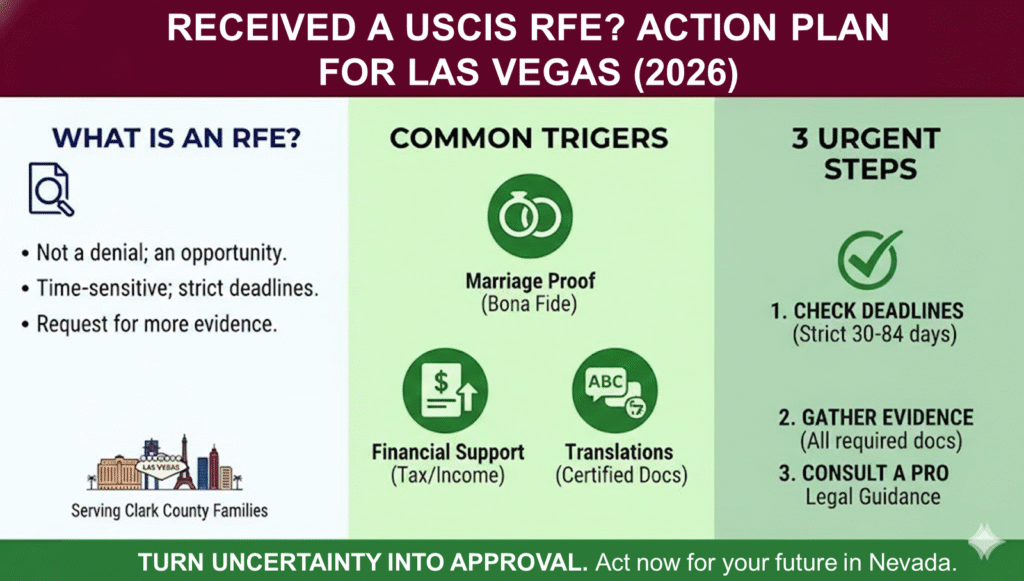
What a USCIS RFE Means in Las Vegas
A Request for Evidence is an official notice that USCIS issues when the officer decides that the initial filing did not include enough “initial evidence” or “additional evidence” to prove eligibility. For Las Vegas families, RFEs often arise in marriage‑based green card cases, family petitions, and employment‑based visas. Under current USCIS policy, officers may deny a case without sending an RFE when the filing is clearly deficient, so receiving an RFE usually means your application is still actively under review. Understanding what the notice is—and what it is not—helps you respond calmly and effectively.
Common RFE Types in Las Vegas
In the Las Vegas area, applicants frequently see RFEs in these situations:
Marriage‑based green cards where the proof of a real relationship is thin.
Family petitions that lack financial documents or proof of qualifying status.
Employment‑based cases that need more evidence of the job offer, the employer’s ability to pay, or the applicant’s qualifications.
Knowing which type of RFE you received helps you gather the right evidence and avoid wasting time on documents that do not address USCIS’s concerns. It also guides you when you decide whether to handle the response yourself or seek legal help.
Deadlines and Timeframes
Your RFE notice includes a strict due date, and you must treat this deadline as non‑negotiable. In many cases, USCIS gives applicants between 30 and 84 days to respond, depending on the type of case and the issues raised. RFEs commonly allow up to 84 days (about 12 weeks), while Notices of Intent to Deny (NOIDs) typically allow only about 30 days. If USCIS does not receive a complete response by the deadline, the agency may deny the case based on the current record or treat the filing as abandoned. Because extensions are rarely available, you should start gathering documents immediately after you receive the notice.
RFE maximum response time in many cases: 84 days.
NOID typical maximum response time: about 30–33 days.
How to Read Your RFE Letter
Most RFEs follow a predictable format, which makes it easier to understand what USCIS wants. As you review your letter, pay close attention to these sections:
Eligibility requirement: The legal standard or rule that USCIS believes you have not fully met.
Deficiency explanation: The reasons USCIS considers your existing evidence incomplete or unclear.
Requested evidence: A list of documents that USCIS suggests you submit to fix the problem.
Submission instructions: Directions on whether to mail the response to a specific address or upload it through your USCIS online account.
Consider reading the letter more than once and highlighting each requested item so you do not miss anything. Keeping a printed copy you can mark up often makes this process easier.
Step‑by‑Step Response Strategy
USCIS normally expects one complete response that includes all requested documents at the same time, rather than multiple small submissions. Because of this rule, you should organize your evidence carefully before you mail or upload anything. The steps below explain how to respond to a USCIS RFE in Las Vegas in a clear, practical way.
1. Create a Requirement Checklist
First, list every document or explanation the RFE mentions, and turn that list into a simple checklist. This technique helps you track what you already have, what you still need, and who must provide each piece of evidence. As you collect each document, mark it off the list so you can see your progress at a glance.
2. Review Previous Submissions
Next, compare the RFE with your original packet. If USCIS asks for a document you already sent, the prior copy may have been hard to read, improperly translated, or misplaced in the file. In that situation, provide a new, clear copy and make sure it is labeled so the officer can easily locate it. It often helps to add a short note in your cover letter explaining that you are resubmitting the document for clarity.
3. Gather Strong Supporting Evidence
Then, focus on gathering “probative” evidence—documents that directly prove the facts that USCIS questions. For example:
Bona fide marriage: Joint Nevada lease agreements, shared utility bills, joint bank statements, insurance policies, and filed tax returns.
Financial support: IRS tax transcripts, current pay stubs, employer verification letters, and signed job offer letters when available.
Translations: Any document in a language other than English must include a complete, certified translation that clearly identifies the translator.
Whenever possible, choose official or third‑party documents instead of informal statements, because they usually carry more weight with USCIS. Organizing these documents by topic makes your packet easier to review.
4. Draft a Formal Cover Letter
After you gather your evidence, prepare a concise cover letter that guides the officer through your response. The letter should:
List your name, A‑number (if any), receipt number, and the form type at the top.
Summarize the issues raised in the RFE in the same order as the notice.
Point to specific exhibits for each issue (for instance, “See Exhibit A – Joint Bank Statements, 2023–2025”).
This structure makes it easier for the officer to verify that you answered every point and shows that you know how to respond to a USCIS RFE in Las Vegas in a professional manner. A clear cover letter can save the officer time and reduce the chance that something important is overlooked.
5. Assemble the Packet
Finally, assemble your response packet in a clean, professional format. Place the original RFE notice on top so the mailroom can quickly route your file. Then organize the remaining pages as follows:
Use standard 8.5″ x 11″ paper whenever you can.
Separate major evidence groups with labeled exhibit tabs or cover sheets.
Avoid bulky binders, oversized clips, or heavy‑duty staples that make scanning difficult.
Keep a full copy—paper or digital—of everything you send for your records.
Before mailing, check your checklist one last time to confirm that nothing is missing. Sending the packet by a trackable mail service can give you proof of delivery and peace of mind.
Common Pitfalls to Avoid
Certain mistakes in an RFE response can lead to fast denials, even when your underlying case is strong. To protect your application, avoid these common problems:
Partial responses: Sending only some of the requested documents, which may cause USCIS to deny based on the incomplete record.
Late responses: Mailing the packet too close to the deadline, because USCIS counts the date it receives your response, not the mailing date.
Uncertified translations: Submitting foreign‑language documents without the translator’s certification and statement of competence.
Irrelevant or “fluff” evidence: Including large numbers of documents that do not address the issues listed in the RFE, which can distract from the key evidence.
Reading your response one last time and comparing it with your checklist often helps catch these errors. If something still feels unclear, consider having a trusted person review the packet.
When to Get Legal Help in Nevada
Some straightforward RFEs can be handled without a lawyer, especially when the missing documents are simple and easy to obtain. However, many applicants in Las Vegas and nearby cities such as Henderson choose to work with an immigration attorney when an RFE involves criminal history, prior immigration violations, gaps in lawful status, or complex employment‑based categories. An experienced lawyer can explain the legal citations in the notice, develop a strategy to address each concern, and assemble the type of detailed, probative evidence that USCIS expects in 2026 adjudications. If you are unsure how to respond to a USCIS RFE in Las Vegas or feel overwhelmed by the process, scheduling a consultation can give you clarity and a concrete plan.
Not Sure If You’re Ready to Talk to a Lawyer Yet?
Get a Free Preliminary Immigration Case Review
Before committing to legal advice, this free review helps you see the landscape—how situations like yours are generally viewed, what processes and forms are commonly involved, and where cases often run into trouble.
It gives you the context and clarity to decide whether and when speaking with a lawyer makes sense.
- ✅ No legal advice.
- ✅ No pressure.
- ✅ Just a clear, high-level roadmap.
For informational purposes only. No attorney-client relationship is created.
Contacting the firm by phone, email, or website does not create an attorney-client relationship. Do not send confidential information until a written representation agreement is signed. The firm is licensed only where stated (e.g., Nevada and California).