Marriage Green Card Timeline in Nevada (2026): What to Expect in Las Vegas and Henderson
The marriage green card timeline in Nevada for 2026 can be a significant source of stress for families seeking stability in Las Vegas or Henderson. Most couples do not struggle because of a lack of bona fide intent; rather, challenges arise because the process involves multiple stages where a single missing item can stall progress.
This guide explains the typical stages, the two primary pathways—consular processing versus adjustment of status—and common delay points to help you plan with clarity.
Legal disclaimer (general information): This content is general educational information, not legal advice. Reading this does not create an attorney-client relationship. Every immigration case is unique. For guidance about your specific situation, consult with a licensed immigration attorney.
Which Path Applies to Your Family?
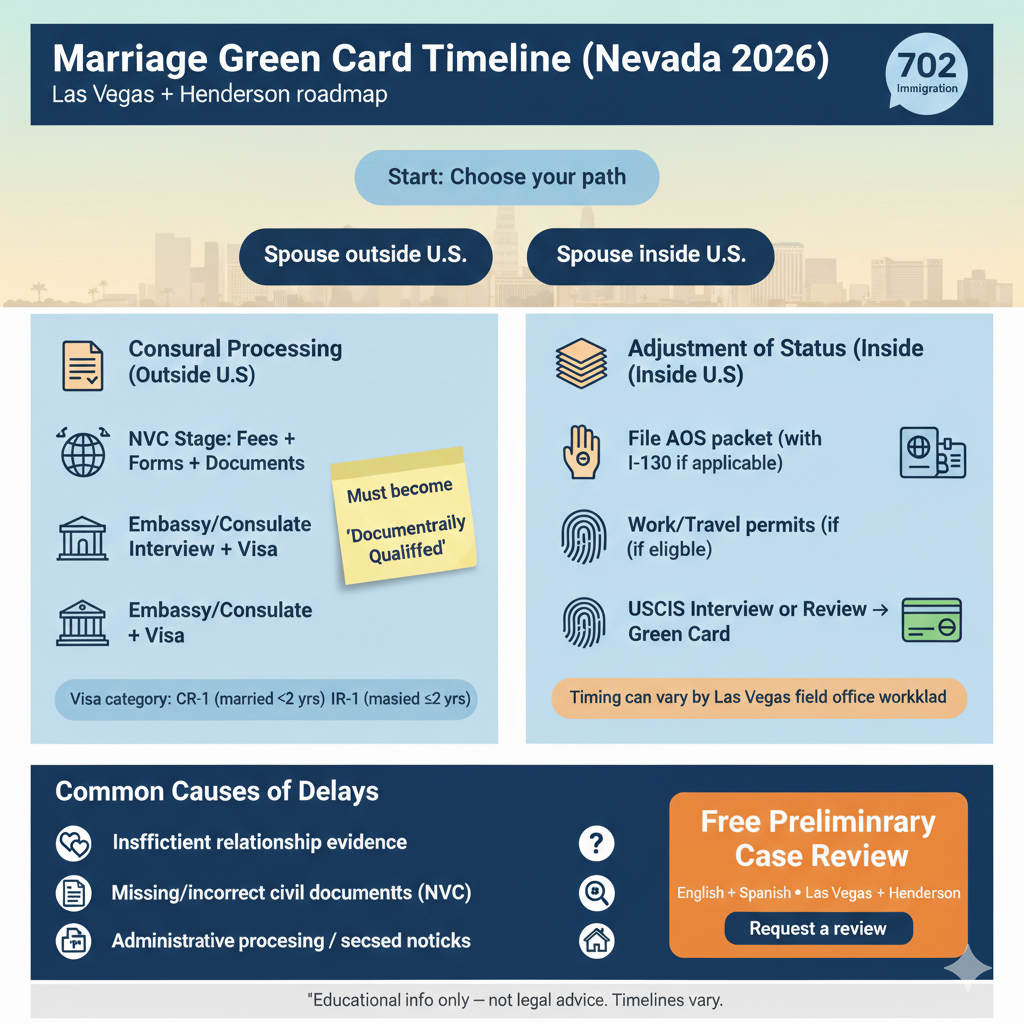
Most marriage-based green card cases begin with a family petition. Following that, the case generally follows one of two routes:
- Consular Processing: Used if the sponsored spouse lives outside the United States.
- Adjustment of Status: Used if the sponsored spouse lives inside the United States and qualifies to apply without departing.
This distinction is vital for families across the Las Vegas Valley (including Las Vegas, Henderson, and North Las Vegas) because it determines where the key steps occur and what the immediate expectations should be.
Government Overview of Spouse Cases
The U.S. Department of State notes that the process begins by filing Form I-130 (Petition for Alien Relative) with USCIS. Once USCIS approves the petition, the case moves to the National Visa Center (NVC) for pre-processing—which includes fee payments and document collection—before an interview is scheduled.
This process functions like a relay race: USCIS handles the initial phase, the NVC manages the middle stage, and the relevant embassy or consulate conducts the final interview.
If Your Spouse Is Outside the U.S. (Consular Processing)
Step 1: USCIS Petition Stage
The petitioner files Form I-130 with USCIS to establish the qualifying relationship. During this phase, the government focuses on relationship validity and basic eligibility requirements.
Step 2: NVC Document Stage
Upon approval, the case moves to the NVC. The center assigns a case number and requests the payment of fees and submission of immigrant visa documents. This includes financial sponsorship forms (Affidavits of Support) and civil documents.
Step 3: Interview Scheduling
Availability for interviews depends on the specific U.S. embassy or consulate. To assist families in setting expectations, the Department of State provides the IV Scheduling Status Tool, which indicates when the NVC is scheduling interviews at specific posts based on when a case became “documentarily complete.”
Estimating Timing
The Department of State publishes a weekly NVC Timeframes page showing current case-creation and review speeds. This tool allows you to verify if your case is progressing within the current average windows.
CR-1 vs. IR-1 Designations
If you have been married for less than two years at the time your spouse enters the U.S. on an immigrant visa, they are granted Conditional Resident (CR) status. In this situation, the couple must file to remove conditions within the 90 days preceding the second anniversary of the spouse’s entry into the country.
If Your Spouse Is Inside the U.S. (Adjustment of Status)
What the Path Includes
If the spouse qualifies to apply from within the U.S., the process typically involves receipt notices, a biometrics appointment (if required), and a final interview or administrative review.
Because USCIS workloads fluctuate, timing varies even for families within the same area of Nevada. Average timelines should be treated as general references rather than guarantees.
Local Planning
Even without international travel, you must plan around local responsibilities such as work schedules and school commitments in Henderson or Las Vegas. Maintaining clear organization remains the most effective way to reduce stress during the wait.
Primary Causes of Marriage Green Card Delays
- Insufficient Relationship Evidence: Officers look for proof of a shared life over time. Evidence should go beyond the wedding day to include shared housing, joint finances, and community ties.
- Document Inconsistencies: Small mismatches in dates, addresses, or name spellings across different forms can prompt a Request for Evidence (RFE), stalling the case for months.
- Missing Civil or Financial Documents: In consular cases, the NVC cannot move a case forward until every required document is uploaded and accepted.
- Administrative Processing: Some cases require additional security or background reviews after the interview. While the pace of this review is outside the applicant’s control, staying responsive to any inquiries is essential.
- Undelivered Mail: Families in the Las Vegas Valley move frequently. Missing a government notice due to an outdated address can result in a case being denied or abandoned.
A Simple 3-Step Plan
- Identify the Correct Path: Determine if you are pursuing consular processing or adjustment of status.
- Compile a Robust Packet: Focus on quality evidence and accuracy rather than rushing the submission.
- Monitor Progress: Utilize official tools like NVC Timeframes and interview scheduling resources to track your status.
Not Sure If You’re Ready to Talk to a Lawyer Yet?
Get a Free Preliminary Immigration Case Review
Before committing to legal advice, this free review helps you see the landscape—how situations like yours are generally viewed, what processes and forms are commonly involved, and where cases often run into trouble.
It gives you the context and clarity to decide whether and when speaking with a lawyer makes sense.
- ✅ No legal advice.
- ✅ No pressure.
- ✅ Just a clear, high-level roadmap.
For informational purposes only. No attorney-client relationship is created.
Contacting the firm by phone, email, or website does not create an attorney-client relationship. Do not send confidential information until a written representation agreement is signed. The firm is licensed only where stated (e.g., Nevada and California).