
USCIS Premium Processing Fee Increase March 2026: What It Means for Las Vegas and Henderson Families
The USCIS premium processing fee increase March 2026 is an official change that may affect how you budget and plan time-sensitive immigration filings for work, school, or an employment-based green card in Nevada. If you live in Las Vegas or Henderson, you may be asking the same question we hear every week: “Should we file sooner, or will rushing create problems?” This guide explains premium processing in plain language, clarifies what USCIS announced, and outlines the smart planning steps many families and employers consider—without hype and without promises.
Disclaimer (general information only): This article is for general educational information and is not legal advice. Reading this does not create an attorney-client relationship. Immigration options depend on your specific facts, so speak with a licensed immigration attorney for guidance about your situation.
What is premium processing (and what does it not do)?
Premium processing is an optional USCIS service that can speed up adjudication (USCIS’s review/decision) for certain eligible filings when you also file a premium processing request (typically Form I-907) and pay the required premium fee. It can be helpful when your family’s stability depends on timing—for example, a job start date, a status extension, or avoiding a long period of uncertainty for a worker in Las Vegas, Henderson, or North Las Vegas.
However, premium processing does not guarantee an approval, does not change the legal eligibility requirements, and does not “fix” weak evidence. In many cases, USCIS may still issue a Request for Evidence (RFE) if something is missing, even when premium processing is requested. Therefore, it’s essential to understand what this service can and cannot accomplish for your case.
When does the premium processing fee increase start?
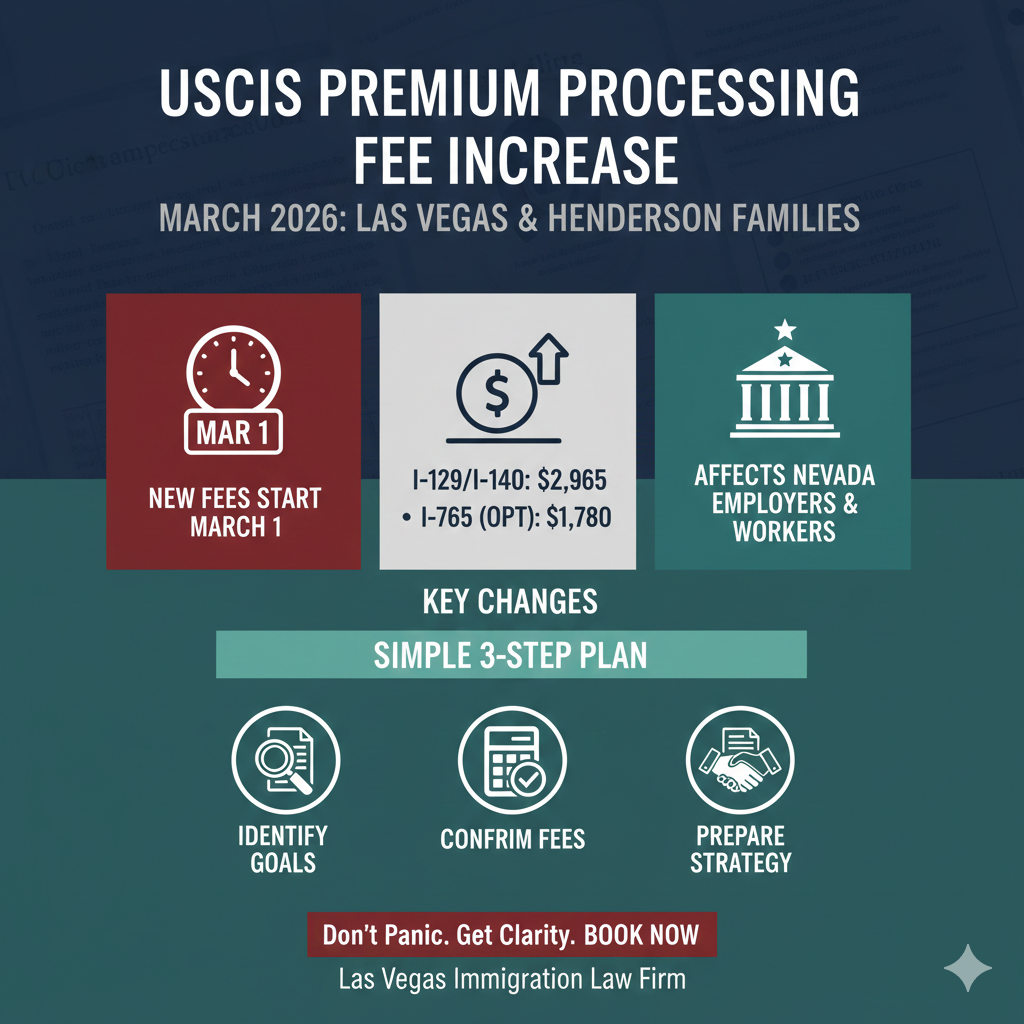
USCIS announced that premium processing fees increase effective March 1, 2026. Additionally, USCIS stated that premium processing requests postmarked on or after that date must include the updated fee.
Because mail timing, postmarks, and package assembly can be strict, it’s wise to confirm the current premium processing fee and instructions right before you file—especially if you’re filing close to the March 1 effective date. In other words, double-checking these details can help you avoid unnecessary delays or rejections.
Who in Las Vegas and Henderson could be affected most?
This change often matters most for people using premium processing for employment-based filings and certain student-related filings (when premium processing is available for that category). Here are common situations we see around the Las Vegas Valley:
Employers in Henderson and Las Vegas sponsoring workers who need faster decisions for project timelines, onboarding, or compliance planning.
Workers and families relying on a single primary income, where delays can create stress about maintaining work authorization and lawful status.
International students in Nevada trying to align work authorization timing with a real job offer (for example, OPT-related timing issues, when premium processing is available).
Employment-based green card cases where a faster petition decision can reduce uncertainty (this depends on the category and the person’s broader immigration strategy).
Every case is different, so what “matters most” depends on your current status, deadlines, and the type of filing. Consequently, evaluating your individual circumstances with a qualified attorney can provide clarity.
How can you plan without rushing and risking mistakes?
When families in Henderson or Las Vegas feel pressure to “beat the deadline,” it helps to use a simple decision framework. This is general guidance—not a substitute for legal advice. Indeed, taking a methodical approach can reduce errors and stress.
Identify your real deadline.
Start by determining your actual deadline. For instance, consider factors such as a job start date, a work authorization expiration date, an employer compliance timeline, or school/work plans that depend on a faster USCIS response. Clarifying your deadline helps you decide whether premium processing is truly necessary.
Confirm eligibility and current fees using official sources.
Before you file, verify that your petition type is eligible for premium processing. Furthermore, USCIS publishes the effective date and directs the public to the official rule publication; always verify your form type and fee amount on USCIS.gov before mailing anything. This step ensures you submit the correct fee and avoid rejections.
File ready cases—don’t file rushed cases.
In many cases, saving money on a fee is less important than filing a complete, accurate packet. A preventable error can cost far more in delays, re-filing, lost time at work, and stress for your family. Therefore, it’s better to take the time to prepare thoroughly rather than rush to meet an arbitrary deadline.
What mistakes cause premium processing delays (even when you pay)?
Premium processing is designed to speed up review, but common problems can still slow things down. Specifically, watch out for these pitfalls:
Paying the wrong fee (especially around an effective-date change), which can lead to rejection of the premium request.
Requesting premium processing for a filing that is not eligible for premium processing.
Submitting an incomplete or inconsistent petition package, which may lead to an RFE and pause progress until a response is filed.
Assuming premium processing increases approval chances; it usually changes speed, not eligibility.
Consequently, understanding these common mistakes can help you avoid unnecessary complications and maximize the benefit of premium processing.
Your 3-step plan
You’re the hero here—not the paperwork. The problem is uncertainty, deadline pressure, and fear of getting it wrong for your family in Nevada. Here’s a straightforward plan to move forward confidently:
Schedule a clarity check: What’s your real deadline and risk?
Build a filing plan: Confirm eligibility, timing, and the correct fees before and after March 1, 2026.
Submit confidently: A complete, well-prepared filing often reduces surprises and improves peace of mind (even when outcomes can’t be promised).
Official links (external)
- USCIS alert (official): https://www.uscis.gov/newsroom/alerts/uscis-to-increase-premium-processing-fees
- Federal Register rule publication (linked by USCIS): https://www.federalregister.gov/documents/2026/01/12/2026-00321/adjustment-to-premium-processing-fees
Not Sure If You’re Ready to Talk to a Lawyer Yet?
Get a Free Preliminary Immigration Case Review
Before committing to legal advice, this free review helps you see the landscape—how situations like yours are generally viewed, what processes and forms are commonly involved, and where cases often run into trouble.
It gives you the context and clarity to decide whether and when speaking with a lawyer makes sense.
- ✅ No legal advice.
- ✅ No pressure.
- ✅ Just a clear, high-level roadmap.
For informational purposes only. No attorney-client relationship is created.
Contacting the firm by phone, email, or website does not create an attorney-client relationship. Do not send confidential information until a written representation agreement is signed. The firm is licensed only where stated (e.g., Nevada and California).