
Your Rights During an ICE Encounter in Las Vegas (2026 Guide)
If you are worried about your rights during an ICE encounter in Las Vegas or Henderson, you are not alone. Many Nevada families feel afraid that one wrong word could affect their future, especially with more immigration enforcement in Clark County.
When you understand your rights during an ICE encounter, you can stay calmer and make better decisions for your family. This 2026 guide explains the basics in simple language so you can prepare before anything happens.
Legal information only – not legal advice
This article provides general information about immigrant rights during ICE encounters and is not legal advice. Immigration law is complex, and every case is different. For advice about your situation, talk with a licensed immigration attorney in your state. Reading this article does not create an attorney-client relationship.
Why are ICE encounters increasing in Las Vegas?
In 2025, the Las Vegas Metropolitan Police Department (LVMPD) applied to rejoin ICE’s 287(g) jail program at the Clark County Detention Center. Local reports state this agreement allows trained jail officers to serve ICE warrants and hold some people for up to 48 extra hours so ICE can pick them up.
Civil rights groups, including the ACLU of Nevada, have challenged this cooperation in court, arguing that it misuses local resources. Community leaders have described fear in Hispanic neighborhoods as “palpable,” especially when families do not know their legal rights. Because of these changes, it is wise for Las Vegas and Henderson families to learn their rights during an ICE encounter now.
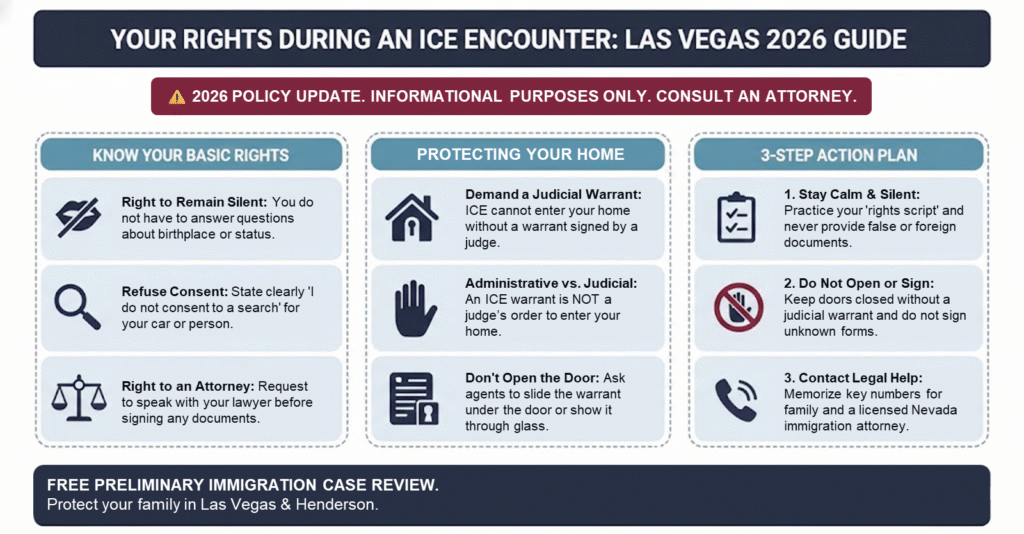
What are your basic rights during an ICE encounter?
In most situations, people inside the United States—regardless of immigration status—have certain constitutional protections. Knowing these protections ahead of time helps you respond instead of reacting in panic.
Right to remain silent
You generally do not have to answer questions about your immigration status, where you were born, or how you entered the U.S. You can say, “I am exercising my right to remain silent.”
Right to say no to a search
In many cases, you can refuse consent to search your body, your car, or your belongings by saying, “I do not consent to a search.”
Right to ask for a lawyer
In immigration cases, the government does not have to give you a free lawyer, but you do have the right to talk with an attorney. You can say, “I want to speak to my attorney.”
Limited right to keep officers out of your home
Under the Fourth Amendment, officers usually need a judicial warrant signed by a judge to enter your home without permission.
There is an important difference between a judicial warrant and an administrative warrant signed only by ICE. Many legal experts recommend not opening the door and asking to see a judge-signed warrant first.
Your rights during an ICE encounter at home in Las Vegas
An ICE visit at home is one of the most frightening experiences for any family. Planning ahead helps you use your rights without escalating the situation.
If ICE knocks on your door:
- Do not open the door unless agents show a warrant signed by a judge with your correct name and address.
- Communicate through the door. Ask, “Do you have a warrant signed by a judge?” Ask them to slide it under the door or hold it to a window.
- Refuse entry for administrative warrants. If it is only an ICE administrative warrant, you can choose to keep the door closed and say, “I do not consent to your entry.”
- Remain silent. You can avoid answering questions about your immigration status or birthplace.
If officers force entry anyway, stay calm and non-violent. Legal challenges may be possible later, but safety is the priority. Additionally, the Clark County School District has stated that immigration officials will not be allowed to enter schools without a warrant.
Your rights during an ICE encounter in public or at work
ICE encounters can also happen on the street, at a traffic stop, or at a job site.
- If stopped in public: Ask, “Am I free to leave?” If they say yes, walk away calmly. Do not run. If they say no, keep your hands visible and repeat, “I am exercising my right to remain silent. I want to speak to my attorney.”
- At a workplace: Whether officers can enter depends on if they are in a public area or a private, non-public area. Workers are encouraged not to assist searches in non-public areas unless an employer or lawyer has agreed.
One of the biggest mistakes is talking too much. Giving detailed answers about your immigration history, showing false documents, or signing papers you do not understand can cause long-term problems.
Common mistakes during ICE encounters
Many people unknowingly give up important rights. Avoid these frequent errors:
- Answering status questions freely: Admissions about birthplace or lack of status can be used in removal proceedings.
- Opening the door too quickly: This can be treated as consent to enter.
- Signing forms without a lawyer: Signing “voluntary departure” forms may prevent you from ever returning to the U.S.
- Lying or showing fake papers: Misrepresentation is a separate legal problem that may permanently affect your immigration options.
What if a family member is detained by ICE in Nevada?
If a loved one is detained, you can search for them using the ICE Online Detainee Locator System (ODLS). You will typically need the person’s A-Number and country of birth, or their full name, date of birth, and country of origin.
In Southern Nevada, ICE detainees are commonly held at the Henderson Detention Center or the Nevada Southern Detention Center in Pahrump. Immigration court hearings are generally scheduled at the Las Vegas Immigration Court on North City Parkway. Contacting an attorney quickly is essential to understand bond options and possible defenses.
Simple 3-step plan for Las Vegas families
- Stay calm and use your “rights script.” Practice phrases like “I am exercising my right to remain silent” and “I want to speak to my attorney.”
- Do not open, do not sign, do not lie. Keep the door closed without a judicial warrant, do not sign forms under pressure, and never provide false information.
- Call your family and an attorney. Memorize key phone numbers for a trusted contact and a licensed immigration lawyer.
Next step: Talk through your specific situation
Imagine feeling calmer the next time you hear a knock at the door. When you understand your rights, you can move from fear to a clear action plan.
If you or a family member has already had contact with ICE—or you want to create a plan before anything happens—you do not have to figure it out alone.
Not Sure If You’re Ready to Talk to a Lawyer Yet?
Get a Free Preliminary Immigration Case Review
Before committing to legal advice, this free review helps you see the landscape—how situations like yours are generally viewed, what processes and forms are commonly involved, and where cases often run into trouble.
It gives you the context and clarity to decide whether and when speaking with a lawyer makes sense.
- ✅ No legal advice.
- ✅ No pressure.
- ✅ Just a clear, high-level roadmap.
For informational purposes only. No attorney-client relationship is created.
Contacting the firm by phone, email, or website does not create an attorney-client relationship. Do not send confidential information until a written representation agreement is signed. The firm is licensed only where stated (e.g., Nevada and California).