Nevada AB 4 (2026): How New ICE School Protections and Detainee Locator Affect Las Vegas Immigrant Families

If you are raising kids in Las Vegas or Henderson, you may carry two fears every day. First: “Will ICE show up at my child’s school?” Second: “If someone is arrested, will I even know where they are?”

Nevada AB 4 answers part of that fear. The law includes Nevada AB 4 ICE school protections and a new detainee locator requirement. These changes do not give anyone legal status. However, they can reduce panic and confusion for many families across Nevada in 2026.

⚠️ Legal disclaimer

This article provides general information about Nevada AB 4. It is not legal advice. Every family’s situation is different. Reading this article does not create an attorney-client relationship. For advice about your case, talk to a licensed immigration attorney.

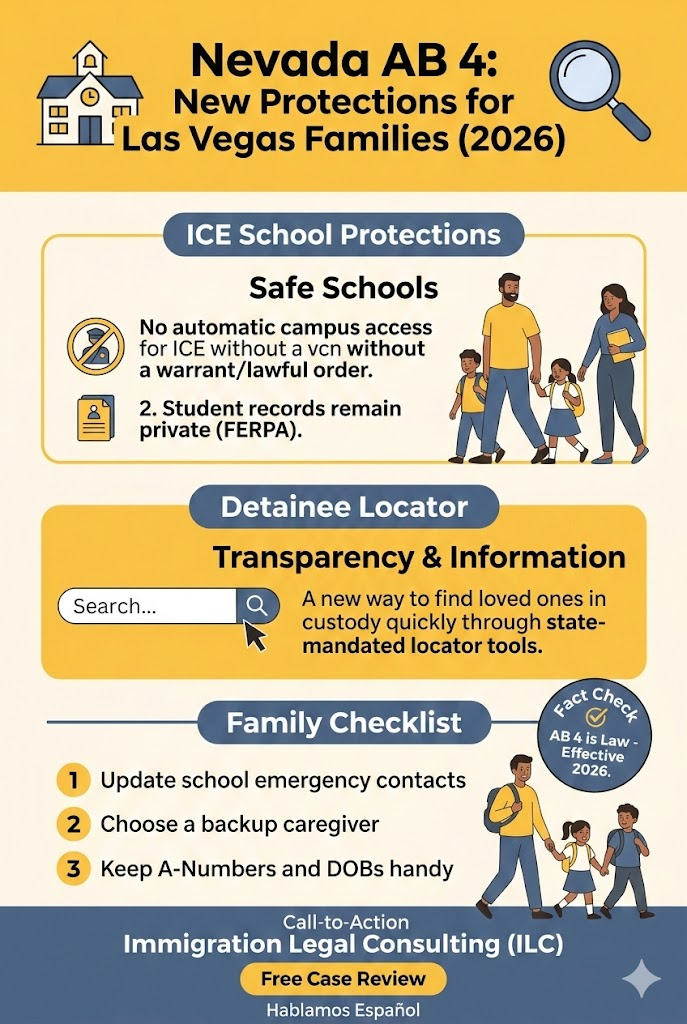
An infographic explaining the 2026 Nevada AB 4 law protections for Las Vegas families, including ICE school access restrictions, student record privacy under FERPA, and a family safety checklist for update school emergency contacts.

What is Nevada AB 4?

Nevada AB 4 passed during the 2025 special legislative session and became law after Gov. Joe Lombardo signed the bills sent to his desk from that session. News coverage describes AB 4 as a major public safety package that lawmakers also used to add immigration‑related limits and transparency measures.

In plain terms, AB 4 does two things that many immigrant families care about:

  1. It adds rules that limit access to public school grounds for certain law enforcement activity, including activity tied to immigration enforcement.
  2. It pushes Nevada toward better custody transparency, including a detainee locator and a running list of people held in certain facilities.

What are the Nevada AB 4 ICE school protections?

Nevada AB 4 ICE school protections aim to reduce immigration enforcement activity on school property. The Nevada Independent reports that the new law curtails ICE’s ability to act on school grounds. It also explains that schools may not grant a law enforcement officer permission to access school grounds unless the officer has a lawful order or exigent circumstances exist.​

News reporting also describes common examples of when officers could still enter: a warrant, an active investigation, “direct pursuit,” or school‑approved educational purposes. In other words, schools do not have to treat every request from an officer as “automatic access” anymore.

What this may look like in Las Vegas (examples only)

  • A school office asks an officer to show a lawful order before staff allow access to campus.​
  • Staff refuse to share private student information without a lawful order.​
  • A school still allows law enforcement onto campus during a serious emergency or active criminal investigation.​

Important: This is general information, and school districts can also add their own policies and training.

Does AB 4 protect student records too?

Yes, in practice it may help, but the main point is this: federal law already protects many student records, and Nevada lawmakers pointed to those protections during the AB 4 debate. For example, The Nevada Independent notes that the Family Educational Rights and Privacy Act (FERPA) limits when schools can release student records.​

So, AB 4 does not “replace” FERPA. Instead, it supports a school environment where staff feel clearer about when they must say no to informal requests for student information.​

🕒 Current as of March 2026: AB 4 passed during the 2025 special session and is now part of Nevada law. School policies can change, so confirm the most current CCSD guidance and state requirements.

What does AB 4 mean for your children in Las Vegas and Henderson?

For many families, the benefit is emotional and practical at the same time.

Your child’s public school may feel safer.

AB 4 aims to keep school from becoming an immigration enforcement zone.​

You may get fewer rumors and less fear.

Staff can point to clear rules when questions arise.​

You still need to plan.

AB 4 does not change federal immigration status or court obligations.​

If you feel anxious, that makes sense. But you are not powerless. You can learn your school’s policy and create a family plan.

What is the Nevada detainee locator in AB 4?

AB 4 also addresses a painful problem: families often cannot find a loved one right after an arrest.

The Nevada Independent reports that AB 4 requires the Nevada Department of Corrections (NDOC) to create a detainee locator for all incarcerated people, including those waiting to be picked up by ICE. The same reporting describes a “running list” requirement for facilities that hold people.

Nevada already has public tools, like NDOC’s offender search, that show publicly available information about incarcerated people. AB 4’s detainee‑locator requirement aims to expand and clarify this kind of access, so families can locate loved ones more quickly.

How can a detainee locator help your family?

When you know where your loved one is, you can act faster. In many cases, fast information helps you:

  • Contact the right facility.
  • Share key details with a lawyer (full name, date of birth, A‑number if available).
  • Ask about bond, hearings, and next steps sooner.

Separately, the federal government also offers an ICE locator for people in ICE custody. USA.gov explains how to use the ICE Online Detainee Locator System. Nevada’s AB 4 locator aims to reduce the “Where are they?” period for people held in state custody or transferred to ICE.

Is Nevada AB 4 a sanctuary law?

Many people ask this question. AB 4 does not make Nevada a “sanctuary state” in the sense of blocking federal immigration law. Supporters describe AB 4 as a public safety law that still allows law enforcement to act, while adding limits and guardrails in sensitive places like schools.

The simpler takeaway is this:

  • AB 4 does not give immigration status.​
  • AB 4 can reduce fear at schools and improve transparency when someone is detained.

What should Las Vegas immigrant families do now?

These steps are general. They are not legal advice.

1) Ask your school about its ICE policy

  • Ask for the school’s written policy on law enforcement access.
  • Ask who the school contacts if an officer appears.
  • Keep emergency contacts updated.

2) Make a basic family safety plan

  • Choose a trusted backup adult for school pickup.
  • Keep important phone numbers in one place.
  • Talk with older kids about what to do if a parent is late.

3) Know how to locate a loved one fast

  • Save official locator links when available (NDOC and, if needed, ICE).
  • Keep key identity details accessible (full name, DOB, A‑number).
  • Call a licensed immigration attorney quickly if detention occurs.

Conclusion: AB 4 can reduce panic, but you still need a plan

Nevada AB 4 gives Las Vegas families two things many people have wanted for years: stronger Nevada AB 4 ICE school protections and a clearer way to locate loved ones in custody. That can reduce fear. It can also give you time to make better decisions.

Still, AB 4 does not replace a long‑term immigration plan. If you have questions about your status or a family member’s risk, talk with a licensed immigration attorney who can review your facts.

Not Sure If You’re Ready to Talk to a Lawyer Yet?

Get a Free Preliminary Immigration Case Review

Before committing to legal advice, this free review helps you see the landscape—how situations like yours are generally viewed, what processes and forms are commonly involved, and where cases often run into trouble.

It gives you the context and clarity to decide whether and when speaking with a lawyer makes sense.

  • ✅ No legal advice.
  • ✅ No pressure.
  • ✅ Just a clear, high-level roadmap.

For informational purposes only. No attorney-client relationship is created.

Contacting the firm by phone, email, or website does not create an attorney-client relationship. Do not send confidential information until a written representation agreement is signed. The firm is licensed only where stated (e.g., Nevada and California).

Leave a Reply

Your email address will not be published. Required fields are marked *