Adjustment of Status vs. Consular Processing in Las Vegas: Which Green Card Path Is Right for You? (2026)

If you are a U.S. citizen or lawful resident ready to bring your family together in Las Vegas, you probably dream of the day the paperwork is finally over. You might be wondering: Should we apply for adjustment of status or consular processing?

Right now, the choice can feel overwhelming. Both paths may lead to a green card, but they work very differently. This isn’t just about filling out confusing legal forms—it’s about the stress of not knowing if your family will face delays, separation, or costly mistakes. No family should have to feel paralyzed by the U.S. immigration system.

We understand how frustrating it is to wait for answers while trying to build your life in Nevada. At Immigration Legal Consulting (ILC), we have helped hundreds of families in Las Vegas navigate the green card process. We know that clear guidance makes the difference between anxiety and confidence.

In this guide, we break down adjustment of status vs. consular processing so you can understand your options.

📌 Disclaimer

This article provides general information about adjustment of status and consular processing. It should not be construed as legal advice. Immigration law is complex, and every case is unique. For advice specific to your situation, consult a licensed immigration attorney. Reading this content does not create an attorney-client relationship.

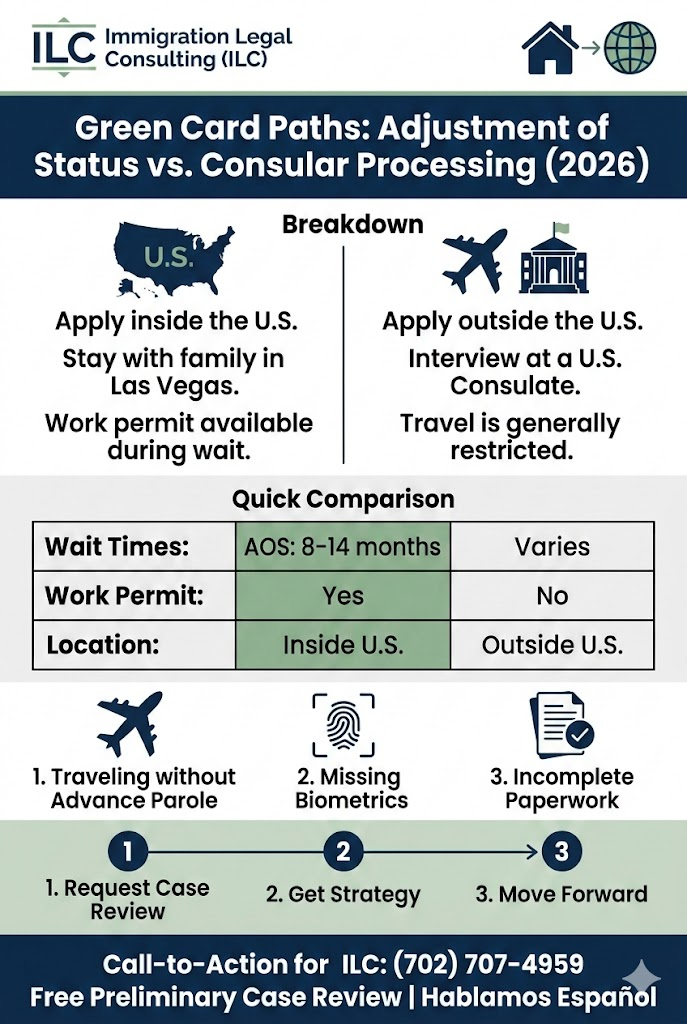
A 2026 comparison guide for Las Vegas families between Adjustment of Status (AOS) and Consular Processing, detailing wait times, work permit availability, and common risks like traveling without Advance Parole.

What Is Adjustment of Status?

Adjustment of status is the process of applying for a green card while you are physically inside the United States. Instead of leaving the country, you complete most of the process right here—at a local USCIS field office or through the mail. The primary form is Form I-485.

For many applicants, the biggest benefit is staying close to family in Clark County. You may also be able to apply for an Employment Authorization Document (EAD) to work legally while your case is pending.

Who May Qualify for Adjustment of Status?

To potentially qualify, you generally need to:

  • Be physically present inside the United States
  • Have entered the U.S. legally through a valid port of entry
  • Be eligible for a green card under a recognized USCIS category (like family-based)
  • Have no legal bars to adjustment, such as certain prior violations

Note: Whether you qualify depends entirely on your individual facts. Consult an attorney to review your situation.

What Is Consular Processing?

Consular processing is the green card path for applicants who are outside the United States—or who cannot adjust their status inside the country.

After USCIS approves your family petition, your case transfers to the National Visa Center (NVC). The NVC collects your fees and documents. Finally, they schedule an interview for you at a U.S. embassy or consulate abroad.

If your loved one lives in another country, this is likely the path you will take. It is also often the required route for people who entered the U.S. without inspection and do not qualify for adjustment.

How Do Adjustment of Status vs. Consular Processing Compare in Las Vegas?

Both routes may lead to a green card, but they differ in key ways. Here is what Las Vegas families ask about most often:

Factor

Adjustment of Status

Consular Processing

Where you apply

Inside the United States

Outside the U.S. at an embassy

Primary form

Form I-485

Form DS-260

Work during wait

May apply for a work permit

Generally not available

Travel during wait

May apply for Advance Parole

Generally restricted

Filing fees

Generally higher overall

Generally lower overall

Estimated wait (2026)

Approx. 8–14 months

Varies widely by country

⏱️ These are general estimates based on USCIS data as of early 2026. Actual times vary by case type and USCIS workload. Check USCIS.gov for current times.

Common Mistakes That Put Your Case at Risk

Many families unknowingly jeopardize their cases by guessing which path to take. Here are common mistakes to avoid:

Mistake 1: Traveling without permission.

If you leave the U.S. while your I-485 is pending without Advance Parole, USCIS may consider your application abandoned.

Mistake 2: Skipping appointments.

Missing a USCIS biometrics or interview appointment often results in sudden denials.

Mistake 3: Submitting incomplete documents.

Missing paperwork can stall your entire consular processing case at the NVC for months.

Your Step-by-Step Path to Clarity

You do not have to figure out this complex system alone. Here is a simple plan to find the right path for your family:

1. Request a Case Review

Schedule a preliminary review with our Las Vegas team to look at your specific immigration history.

2. Get a Customized Strategy

We will explain whether adjustment of status or consular processing fits your unique situation—in plain language.

3. Move Forward with Confidence

Let our team handle the paperwork and deadlines while you focus on your family.

Not Sure If You’re Ready to Talk to a Lawyer Yet?

Get a Free Preliminary Immigration Case Review

Before committing to legal advice, this free review helps you see the landscape—how situations like yours are generally viewed, what processes and forms are commonly involved, and where cases often run into trouble.

It gives you the context and clarity to decide whether and when speaking with a lawyer makes sense.

  • ✅ No legal advice.
  • ✅ No pressure.
  • ✅ Just a clear, high-level roadmap.

For informational purposes only. No attorney-client relationship is created.

Contacting the firm by phone, email, or website does not create an attorney-client relationship. Do not send confidential information until a written representation agreement is signed. The firm is licensed only where stated (e.g., Nevada and California).

Leave a Reply

Your email address will not be published. Required fields are marked *