Sign Up for our FREE newsletter Here →
Cancellation of removal can be one of the most important defenses in immigration court for families in Las Vegas, Henderson, and across Nevada. In some cases, this relief may allow a person in removal proceedings to remain in the United States, and for some applicants it can lead to lawful permanent residence.
That possibility gives many families hope, but the rules are strict. You usually must prove years of presence, good moral character, no disqualifying convictions, and a very high level of hardship to a qualifying relative. This guide explains the general rules, the risks, and the steps many Nevada families take to prepare.
This article provides general information about cancellation of removal and should not be construed as legal advice. Immigration law is complex, and every case is unique. Reading this content does not create an attorney-client relationship. For advice specific to your situation, consult a licensed immigration attorney.
Cancellation of removal is a form of relief an immigration judge may grant during removal proceedings. The statute recognizes two main versions: one for lawful permanent residents and another for certain people who are not lawful permanent residents.
For many families in Las Vegas, the question is usually about the non-LPR version. In general, that is the form of relief people discuss when they talk about the “10-year rule” in immigration court. If the judge grants this relief, removal is canceled. For some applicants, the relief can also include adjustment to lawful permanent resident status.
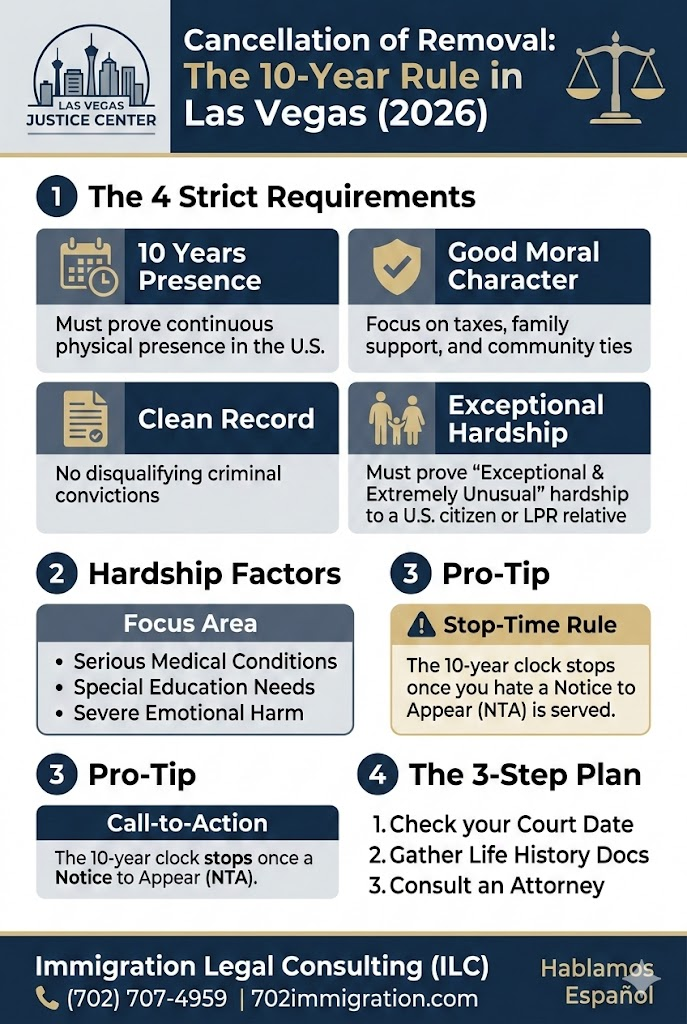
For a non-LPR case, the law sets four main requirements. A person generally must prove all four, not just one or two.
The statute requires at least 10 years of continuous physical presence in the United States. That requirement is one reason families often gather school records, leases, bills, tax records, and medical paperwork covering many years. A separate rule, often called the stop-time rule, can cut off the accumulation of time after service of a Notice to Appear.
The applicant must show good moral character during the required period. This part of the case may involve criminal history, honesty issues, family support, tax compliance, and community ties.
The law also bars applicants with certain convictions under the immigration statute. Even an offense that seemed minor in criminal court can have serious immigration consequences.
This is often the hardest part of the case. The applicant must show that removal would cause “exceptional and extremely unusual hardship” to a qualifying U.S. citizen or lawful permanent resident spouse, parent, or child. Ordinary hardship is usually not enough.
People in removal proceedings before the Las Vegas Immigration Court may ask about cancellation of removal if they believe they meet the legal requirements. The Las Vegas Immigration Court is located at 110 North City Parkway, Suite 400, Las Vegas, NV 89106.
In general, families may start exploring this relief when:
Judges do not grant cancellation of removal just because separation would be painful. Hardship usually must be much more serious than the normal hardship expected in deportation cases. Families may present evidence involving:
You cannot control every court deadline, but you can take practical steps to reduce confusion.
If you have a hearing in Las Vegas, confirm your next court date and the current stage of the process.
Collect proof of long-term residence, family ties, taxes, and medical records early.
Missing a deadline or misunderstanding a requirement can permanently hurt a case.
For some families in Nevada, cancellation of removal offers a real chance to stay together. However, the legal standard is high. If your family is facing immigration court, clarity matters. The sooner you understand the rules and start preparing records, the better positioned you may be to protect what you have built.
Get a Free Preliminary Immigration Case Review
Before committing to legal advice, this free review helps you see the landscape—how situations like yours are generally viewed, what processes and forms are commonly involved, and where cases often run into trouble.
It gives you the context and clarity to decide whether and when speaking with a lawyer makes sense.
For informational purposes only. No attorney-client relationship is created.
Contacting the firm by phone, email, or website does not create an attorney-client relationship. Do not send confidential information until a written representation agreement is signed. The firm is licensed only where stated (e.g., Nevada and California).
© 2021 Immigration Legal Consulting LLC. All rights reserved.
Attorney Advertising. This information is designed for general information only. The information presented should not be construed to be formal legal advice nor the formation of a lawyer/client relationship. Past results and testimonials are not a guarantee, warranty, or prediction of the outcome of your case, and should not be construed as such. Past results cannot guarantee future performance. Any result in a single case is not meant to create an expectation of similar results in future matters because each case involves many different factors, therefore, results will differ on a case-by-case basis. By providing certain contact information herein, you are expressly authorizing the recipient of this message to contact you via the methods of communication provided.