
F1 Visa Bulletin April 2026 Las Vegas: Unmarried Adult Children of U.S. Citizens May Be Closer to a Green Card Than They Think
The April 2026 Visa Bulletin brought important news for many Las Vegas families. The State Department moved the F1 category forward by as much as six months for most countries. That movement appears in both the Final Action Dates chart and the Dates for Filing chart. For unmarried adult children of U.S. citizens who have waited for years, this update may open a real next step.
General Information Disclaimer
This article provides general educational information about the April 2026 Visa Bulletin and the F1 category. It is not legal advice. Every immigration case is different. Reading this article does not create an attorney-client relationship. Please consult a licensed immigration attorney before taking immigration action.
What is the F1 visa category?
The F1 category is the first family-sponsored preference. It covers unmarried sons and daughters age 21 and older whose parent is a U.S. citizen. It does not cover minor children of U.S. citizens. Those children usually qualify as immediate relatives and do not face the same annual visa limits.
F1 cases do face annual limits. Because of that, families must wait based on a priority date. In most cases, the priority date is the date the U.S. citizen parent filed Form I-130.
What changed in April 2026?
The April 2026 Visa Bulletin shows meaningful F1 movement. For most countries, the F1 Final Action Date moved to May 1, 2017, and the Dates for Filing moved to March 1, 2018.
Mexico and the Philippines have different dates. For Mexico, the F1 Final Action Date moved to February 15, 2007. For the Philippines, it moved to May 1, 2013. Even where the movement was smaller, it still matters for families who have been waiting a long time.
Why does this matter for Las Vegas families?
Many Las Vegas and Nevada families have adult children waiting in the F1 line. When dates move forward by months instead of days, more families may suddenly be close to filing or approval. That can change planning for work, travel, and long-term stability.
This is also where legal guidance becomes valuable. A family may see progress in the bulletin and assume they can file right away. In many cases, that is not enough. They still need to check the right chart, confirm their priority date, and review whether adjustment of status is actually available.
How do you know if you may file now?
Start with your priority date. Then compare that date to the F1 cutoff for your country in the April 2026 Visa Bulletin. If your priority date is earlier than the Dates for Filing cutoff, you may be able to submit Form I-485 if you are otherwise eligible.
Next, check whether USCIS is using the Dates for Filing chart for family-based cases in April. USCIS must confirm that separately each month. That is why checking uscis.gov/visabulletininfo matters before you send anything.
What if the dates move backward later?
That risk is real. Visa Bulletin dates can advance and then move backward. This is called retrogression. If demand rises too quickly, the government may set an earlier cutoff in a future month.
That is why timing matters. A family that qualifies to file in April may not qualify in May or June if the dates change. For families who have already waited years, missing a short filing window can be frustrating and expensive.
Does this include Mexico and the Philippines?
Yes, but the timeline is different. Mexico and the Philippines still face slower movement than most other countries because of demand and annual limits. Even so, the April 2026 bulletin still moved those categories forward.
That means families from those countries should not ignore this update. If your priority date is close, now is a smart time to review your case and prepare your documents. Waiting until the next bulletin may create more uncertainty.
What mistakes should families avoid?
Families often lose time because of preventable errors. Common problems include:
- Using the wrong chart for the month.
- Misreading the priority date on the I-130 notice.
- Assuming bulletin movement automatically means approval.
- Waiting too long to collect supporting documents.
- Filing without checking whether the applicant is otherwise eligible to adjust status.
A careful review may help avoid those mistakes. It may also show whether your family should prepare now or wait for a later step.
What are the next steps?
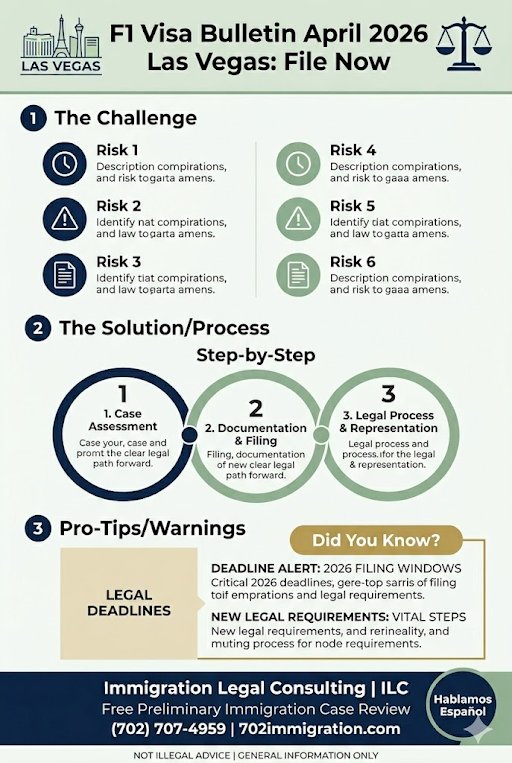
Here is a simple 3-step plan:
- Find the priority date on the I-130 receipt or approval notice.
- Compare that date to the April 2026 F1 cutoff for your country.
- Get a legal review before filing anything.
For many families, the hardest part is not the form itself. It is knowing whether this month’s Visa Bulletin really creates an opportunity. Clear guidance can help you move with more confidence.
Conclusion
The April 2026 Visa Bulletin brought real progress for unmarried adult children of U.S. citizens. For many families in Las Vegas, that progress may mean a filing opportunity is finally getting closer. It may also mean this is the right time to review your priority date, your eligibility, and your next step.
Not Sure If You’re Ready to Talk to a Lawyer Yet?
Get a Free Preliminary Immigration Case Review
Before committing to legal advice, this free review helps you see the landscape—how situations like yours are generally viewed, what processes and forms are commonly involved, and where cases often run into trouble.
It gives you the context and clarity to decide whether and when speaking with a lawyer makes sense.
- ✅ No legal advice.
- ✅ No pressure.
- ✅ Just a clear, high-level roadmap.
For informational purposes only. No attorney-client relationship is created.
Contacting the firm by phone, email, or website does not create an attorney-client relationship. Do not send confidential information until a written representation agreement is signed. The firm is licensed only where stated (e.g., Nevada and California).